

A Descriptive Analysis of the Post-COVID-19 Labor Market for Recent Graduates
Introduction
the post COVID-19 normalization of unemployment in 2022, the labor market for young graduates has been a fiercely debated topic among students, recruiters and political commentators (U.S. Bureau of Labor Statistics n.d.; Smith 2023). Students and young graduates’ express frustration over high underemployment, low wages, degree mismatch, and the rising number of applications needed to secure one return offer (Smith 2023; Abel, Deitz, and Su 2014; Bell and Blanchflower 2011). Young graduates express concern over the role of AI in job displacement and in the hiring process (Smith, Johnson, et al. 2024; Lee and Williams 2023). On the other hand, 80 percent of employers feel that young graduates lack problem solving skills and 65 percent believe that universities fail to prepare students to meet industry needs (Sutherland and Hughes 2024; Rodriguez and Gray 2023). Employers and students alike report using AI to aid in applying for and filtering applications respectively (Lee and Williams 2023; Smith, Johnson, et al. 2024). Some political commentators blame universities and question the value of a college degree while others note low wages and high costs of living for young graduates (Smith 2023; Abel, Deitz, and Su 2014; Bell and Blanchflower 2011). Beyond social discourse, there is growing concern among economists that individuals who graduated during or right after the COVID-19 pandemic may suffer from life-long cyclical scarring like cohorts during the Great Recession of 2008 (Kahn 2010; Oreopoulos, von Wachter, and Heisz 2012; Hughes and Carter 2024).
Considering the growing social and academic concern over the topic, our study aims to examine the condition of the post-COVID-19 labor market for young graduates by utilizing multiple linear regression and Bartik instruments to estimate job matching efficiency and the effect of labor demand on unemployment (Blanchard and Diamond 1989; Barnichon and Figura 2015; Bartik 1991; Goldsmith-Pinkham, Sorkin, and Swift 2020; Hershbein and Kahn 2018). In consonance with research on the labor market during the 2008 recession, we hypothesize that demand has a positive effect on both unemployment and underemployment and expect matching efficiency to decrease (Kahn 2010; Bell and Blanchflower 2011; Abel, Deitz, and Su 2014; Barnichon and Figura 2015; Oreopoulos, von Wachter, and Heisz 2012; Hughes and Carter 2024).
Literature Review
We base the framework of our analysis on the search and matching model of unemployment (job findings vs separations) and the Beveridge curve relating vacancies to unemployment (Blanchard and Diamond 1989; Barnichon and Figura 2015). Movement along the Beveridge curve is classically interpreted as a change in aggregate labor demand while shifting of the curve is attributed to changes in matching efficiency (Barnichon et al. 2012; Şahin et al. 2014). Recent estimates of aggregate matching functions show that the residual matching efficiency is heavily cyclical and falls during periods of recession implying that shifts in matching efficiency can account for a significant share of unemployment variation (Barnichon and Figura 2015). Related work shows that entering the labor force during a recession is associated with persistent scaring effects on earnings and job quality (Kahn 2010; Oreopoulos, von Wachter, and Heisz 2012). Even outside of recessions, young graduates experience a higher rate of mismatch and underemployment relative to the aggregate labor force.
A separate literature studies the measurement of labor demand and the effect of exogenous demand shocks on unemployment. Vacancy data and online job postings data are now widely accepted and frequently used proxies for local labor demand to measure the impact of shocks on the skill composition of available jobs (Hershbein and Kahn 2018). In parallel, shift-share (Bartik) instruments use predetermined local industry shares interacted with national growth rates to construct exogenous local demand shifters. We base our construction of Bartik instruments on recent work which clarifies the identification and assumptions implicit to the method (Bartik 1991; Goldsmith-Pinkham, Sorkin, and Swift 2020). The labor demand studies and the matching model studies primarily focus on the aggregate labor market, rather than the labor market for young graduates, and rarely include matching efficiency or demand-unemployment models for young graduates (Barnichon and Figura 2015; Abel, Deitz, and Su 2014). In our relatively short time frame (2020-2024), we follow a common assumption of graduation-in-recession literature of treating local labor supply flow as slow moving, predetermined, and weakly associated with cyclical shocks Kahn 2010; Oreopoulos, von Wachter, and Heisz 2012). Therefore, we exclude the improbable association between local labor supply and unemployment from our broader framework. Instead, we focus on the primary shifters of the Beveridge curve, exogenous demand shocks and matching efficiency.
Research Methods
Panel Structure
Our analysis is conducted using a core panel of CBSA x Year x Quarter which we construct in section 4. The core panel contains variables for unemployment, underemployment, jobs finding, postings, vacancy rate, Bartik index, a JOLTS control, and BA flows on a common set of CBSAs over time. Let i denote CBSA codes and q calendar quarters; the core panel spans 261 CBSA codes across 20 quarters (2020-2024). All variables were constructed independently then left joined into the core panel dropping all rows with missing CBSA codes and rows with insufficient data for quarters yielding a balanced panel that has strong coverage across all variables.
Estimating Demand on Unemployment and Underemployment
To calculate the association between labor demand and unemployment, we estimate a two-stage least squares model (2SLS) where the outcome is the unemployment rate for young graduates and the endogenous regressor is our cumulative postings-based demand measure. Let uiqtBA, 22–27 denote the unemployment rate for young graduates in CBSA i and quarter (q, t) and uiqtnonBA, 22–27 the unemployment rate for young individuals without a BA in CBSA. Let Dsumiqt denote the cumulative BA postings demand measure equal to the sum of the four quarter lags. Our main 2SLS specification is: uiqtBA, 22–27 = αi + λqt + βDsumiqt + θ uiqtnonBA, 22–27 + εiqt with Dsumiqt instrumented using four lags of the Bartik demand shifter: Dsumiqt = αi + λqt + δ uiqtnonBA, 22–27 + π1E1, iqt + π2E2, iqt + π3E3, iqt + π4E4, iqt + νiqt where Eℓ, iqt = lagℓ(Bartikit) for ℓ = 1…4, and αi and λqt denote CBSA and quarter by year fixed effects in both stages, standard errors are clustered at the CBSA level. We expect the Bartik index to be a relevant for postings demand because it interacts predetermined occupational shares with national occupation growth shocks, so CBSAs that are more specialized in nationally expanding occupations should experience associated changes in vacancies and postings. The exclusion restriction is plausible because CBSA fixed effects, time fixed effects, and non-BA controls are used, however, variables outside the scope of our analysis like wages or job quality may associated with the Bartik instrument and unemployment. The main specification is redefined to estimate two placebos, one for individuals with a BA aged 27–35 and another for individuals aged 22–27 without a BA where uiqtnonBA, 22–27 is omitted as a control. To obtain the main estimate and placebo estimates for underemployment, we replace the dependent variable uiqtBA, 22–27 with the variable for underemployment UnderEmpiqt while keeping Dsumiqt as the endogenous regressor instrumented with the four lags of the Bartik index. The underemployment estimates are computed using the same specification for unemployment with a control for aggregate underemployment minus the placebos.
Estimating the Matching Function and Matching Efficiency
To estimate the matching function, we use a log matching function on CBSA × quarter flows and unemployment stock for young graduates. For each CBSA i and quarter q, let Miq be the CPS weighted amount of unemployment to employment status transitions (matches) for young graduates. Let Uiq be the CPS weighted stock of unemployed young graduates at the start of a given quarter. We estimate the fixed effects regression: log Miq = λi + τq + αlog Uiq + εiq where λi is CBSA fixed effects, τq is quarter by year fixed effects, and α is the elasticity of matches in terms of unemployment. Standard errors are clustered at the CBSA level. We extract the estimated time fixed effects τq and interpret them as log Aq to construct quarter level relative matching efficiency: $$A_q^{\text{rel}} = \exp\big(\tau_q - \overline{\tau}\big)$$
Data
Unemployment Rate
The primary outcome is the quarterly unemployment rates for recent graduates. We started by downloading CPS monthly microdata files from the US census website, between 2020 Q1 and 2024 Q4. We restricted the CPS sample to individuals who were aged 22-27, with a BA, and years 2020-2024 and drop cells with non-positive person weights. When CBSA codes were available, cells were grouped into unique CBSA codes, when unavailable a variable was generated from state and county codes and merged into CBSA groups via an external county-CBSA crosswalk. CBSA level totals for each CBSA code, year, and month are created by summing person weights over individuals in the labor force and over individuals unemployed to compute monthly unemployment rates. CBSA monthly totals are then aggregated to calendar quarters by summing the weighted CBSA cells. This yields a CBSA x quarter x year panel with unemployment rates of young graduates and the associated quarterly labor force weights which are merged into the core panel. A control for aggregate unemployment was constructed in the same manner and joined to the core panel.
Underemployment Rate
Variables for the occupational BA-share and underemployment were created to measure how many young college graduates are working in jobs that do not require a BA for each CBSA i and month m. Drawing on the CPS monthly microdata, we restrict the sample to individuals who have a BA, positive person weights, valid CBSA codes, and are aged 22 t27. The level of the construction thus far is the reference month m where each observation is on worker j, in CBSA i, with CPS weights wjm, and detailed occupation code occ.
We define how BA-heavy each occupation is in the overall labor market using CPS observations for all individuals in the labor force. We computed for each occupation o the CPS weighted share of workers with a BA or higher and define the BA share of occupation o as: $$\text{BAshare}_o = \frac{\sum_{j \in o} w_{j}\,\mathbf{1}\{\text{BA+}\}} {\sum_{j \in o} w_{j}}$$ The index is bounded between 0 and 1, with a small score representing a lower BA-share and a larger score representing a higher BA-share for a given occupation. The BA share index is then mapped back onto a new young graduates dataset, giving each young graduate a score for their occupation. Occupations such as retail and food services scored low on the scale while occupations such as banking and software engineering had high scores.
We define underemployment as the share of employed young graduates working in occupations where most workers do not have a BA at the CBSA month level. Let τ be the cutoff for a BA job. We set τ to 0.6 so that occupations where BAshareo < 0.6 are classified as non BA occupations and occupations where BAshareo > 0.6 are classified as BA occupations. For each CBSA i and month m, we compute the CPS weighted underemployment rate for young graduates: $$\text{UnderEmp}_{im} = \frac{\sum_{j \in (i,m)} w_{jm}\,\mathbf{1}\{\text{BAshare}_{o(j)} < t\}} {\sum_{j \in (i,m)} w_{jm}}$$ The numerator counts, in CPS weighted units, the number of employed young graduates in CBSA i and month m working in non-BA occupations while the denominator counts the total CPS weighted number of young workers within a CBSA. The resulting variable UnderEmpim is a rate between zero and one that measures the rate of underemployment among recent graduates in each labor market for each month. The underemployment rate is then joined into the core panel by CBSA × year × quarter. An aggregate underemployment control was constructed in the same way and merged to the core panel.
Job-Finding Rate
Variables for unemployment stock Uiq and
flow from unemployment to employment Miqwere
created to calculate the job finding rate (fiq)
for young graduates. Drawing on the CPS monthly microdata, we restrict
the sample to individuals who are aged 22-27, with at least a bachelor’s
degree, and have positive person weights. Individuals are identified
across months using the CPS household and person identifiers
(hrhhid, pulineno) while their labor force
status is recorded as employed, unemployed, or not in the labor force.
For each individual observed in consecutive months we identify an
unemployment to employment transition where an individual is unemployed
in month m − 1 and employed in
month m and remains in the
same CBSA. The monthly flow of matches, measured in levels, represents
the CPS-weighted number of young graduates in CBSA i who move from unemployment to
employment between month m − 1
and m. Mim = ∑jwj, m − 1 1{U → E
in i}. The corresponding unemployment stock is the
CPS-weighted number of unemployed young graduates for any given CBSA
i at the start of each
month:
Uim = ∑jwj, m − 1 1{U in i}. The monthly measures for Mim and Uim are aggregated to the CBSA x quarter level by summing both variables over months within each calendar quarter yielding Miq and Miq respectively. Miq represents the number of matches for young graduates in CBSA i during quarter q while Uiq represents the size of the unemployed risk set at the start of those months for any given CBSA. The job finding rate for young graduates in CBSA i and quarter q is defined as: $$f_{iq} = \frac{M_{iq}}{U_{iq}}.$$ fiq measures the fraction of unemployed young graduates whose status changed to employed within the quarter. The job finding rate fiq for each CBSA x year x quarter is merged into the core panel.
Job Postings Index
We construct a job postings index by using the daily metro data from Indeed’s Hiring Lab job postings tracker. The raw data reports a measure of job postings expressed as a percent deviation from a pre-COVID-19 level Jid for each CBSA i on day d. We transform this percent difference measure into a relative level by computing Lid: $$L_{id} = 1 + \frac{J_{id}}{100}.$$
Lid is averaged across quarters and CBSA to create a quarterly average level Piq for postings: $$P_{iq} = \frac{1}{D_{iq}} \sum_{d \in q} L_{id},$$ where Diq is the number of daily observations available for any given CBSA i in quarter q. Values constructed with less than 30 days or missing CBSA ids are dropped. Piq is then log transformed and the resulting CBSA × quarter × year postings file is joined with the core panel.
Bartik Index
We calculate the CBSA × year × quarter Bartik index from the raw BLS Occupational Employment and Wages Statistics (OEWS) data. For each discrete occupation o, CBSA i and calendar year t, let Eiot denote OEWS employment for any given occupation, CBSA, and year. First, we summed all employment counts across all OEWS rows that share the same CBSA, occupation, and year. Using a fixed baseline at t0 = 2020, we computed the CBSA × occupation employment shares: $$s_{io}^{(0)} = \frac{E_{io t_0}}{\sum_{o'} E_{i o' t_0}}$$
So that the sum over all occupations o of sio(0) = 1 for each CBSA. Then we aggregated the new table to the national level. EotUS denotes the total U.S. employment in occupation o in year t and was obtained by summing state-level employment. For each occupation × year cell we compute the annual log change in national employment: got = log EotUS − log Eo, t − 1US
All missing first differences were set to 0. The Bartik variable for CBSA i in year t is a share-weighted average of the national occupation-specific shocks:
Bit = ∑osio(0) ⋅ got
Bit can
be interpreted as an index of predicted growth for local labor demand
driven purely by national shifts in occupational demand and
predetermined local occupational shares. Finally, we assign the value of
each year to each quarter within a year and merge the resulting
Bartik_entry variable to the core panel.
Vacancy Rate
We constructed a proxy for the CBSA × quarter vacancy facing young graduates by combining our job postings panel with our CPS measure of BA employment. Starting with postings, we extract the total number of active postings Piq from each CBSA i and calendar quarter q. We use CPS microdata aggregated to the CBSA × quarter level for young graduates to obtain our measure for the CPS-weighted size of the labor force LAiqBA and the CPS-weighted number of unemployed workers UiqBA. We merge the two along common sets of CBSA code, year, and quarter. We then compute the implied employment stock for young graduates in CBSA i during quarter q: EiqBA = LAiqBA − UiqBA.
EiqBA counts CPS-weighted employed young graduates. We define the vacancy rate as the share of jobs that are unfilled, where postings are treated as open vacancies and employed workers as filled positions. For each CBSA i and quarter q we compute: $$v_{iq}^{BA} = \frac{P_{iq}}{P_{iq} + E_{iq}^{BA}}.$$
We drop all cells where Piq + EiqBA = 0. The resulting variable viqBA is our CBSA × quarter measure of the vacancy rate for young graduates. viqBA was joined into the core panel.
Check if any other variables need to be described in data. Vacancy rate.
BA Flows IPEDS
We constructed a flow variable, flow_ba_it, to measure
the new supply of recent graduates entering each CBSA. Drawing on IPEDS,
we restrict the sample to individuals aged 22–27 between the years of
2020 and 2024. The sample is further restricted to only include cells
that have institutional identifiers and a completions count. We only
keep cells that have a completions count which corresponds to
BA-associated indicators (credential_level,
creddesc, or awardlevel_desc). Because
indicators for BA change across the sample, searching for multiple
indicators is necessary. We then only keep four columns: institutional
identifier (unitid), calendar year (_year),
zip code (_zip), and the chosen completions count
(_n). Rows missing _year are dropped, and rows
with missing or negative values of _n are dropped. For each
institution-by-year, we collapse differences across program, sex, and
other variables by summing _n, yielding the total count of
bachelor’s completions per institution per year.
A fourth variable, cbsa, is created to map institutions
onto their corresponding CBSA. A new file lists institutions and their
corresponding zip codes. Using the crosswalk bridge created in
Section 2.1, five-digit CBSA codes are generated for each institution’s
five-digit zip code. The resulting zip-code–CBSA crosswalk is left
joined to the institution-by-year file. The zip-code variable is then
dropped, and any rows missing cbsa are dropped.
Finally, we aggregate completions to the CBSA-by-year level by
summing _n for each institution j across each CBSA i within each year t. For each CBSA i and year t, let njt
denote the total number of bachelor’s degrees completed at institution
j in year t, and let 𝒥(i) be the set of institutions
located in CBSA i. The BA
supply measure flow_ba_it is then flow_bait = ∑j ∈ 𝒥(i)njt,
the total number of bachelor’s degrees awarded by institutions in CBSA
i in calendar year t. The final data set is left joined
to the core panel preserving CBSAs and their associated BA flows for
each year.
Analysis
Descriptive Statistics and the Beveridge Curve
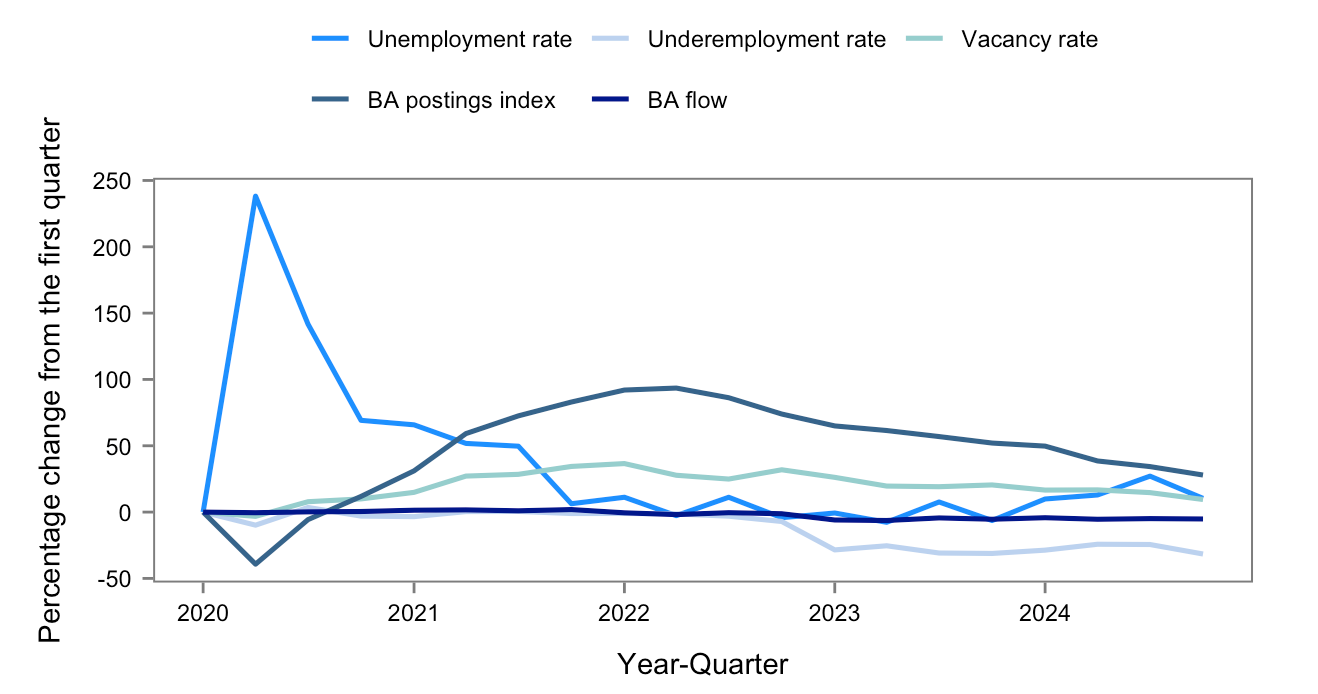
Figure 1 is constructed by pulling cells from the young graduate unemployment rate, underemployment rate, vacancy rate, BA postings index, and BA flows aggregated across each CBSA and quarter. Variation is measured as the percentage change from the first quarter of 2020. The unemployment rate spikes during 2020, indicating the COVID-19 labor market shock, and subsequently normalizes during 2022. After 2022, the unemployment rate has very slowly but steadily increased to five percent at the end of 2024. The BA postings index dips during 2020, recovering to a peak in Q2 2022 and declining steadily afterwards. The vacancy rate dips slightly during 2020, increases between 2020 and 2022, and then slowly decreases. The BA supply flow remains nearly flat, while underemployment is initially flat but begins to decrease during Q2 2022. Note the inverse relationship between the vacancy rate and unemployment rate; to better understand this relationship, we plot a Beveridge curve for young graduates.
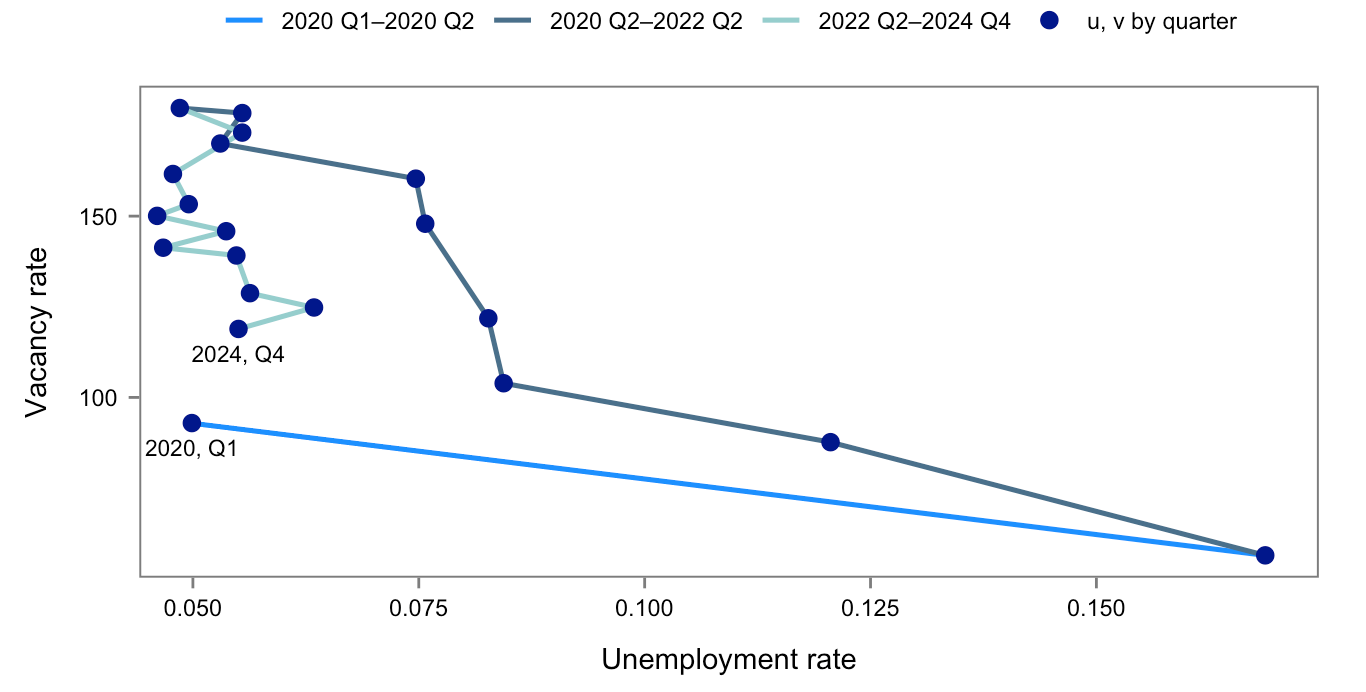
Figure 2 shows the Beveridge curve for young graduates by mapping vacancy and unemployment rates across the 5-year period per quarter. The curve exhibits three phases: (1) Q1 2020–Q2 2020, the COVID shock, in which there is movement outward along the curve as the recession decreases vacancies and increases unemployment; (2) Q2 2020–Q2 2022, the post-COVID shock period, in which the curve steepens as unemployment decreases and vacancies increase; and (3) Q2 2022–Q4 2024, the post-normalization period, in which the curve becomes unusually steep as vacancies rapidly decrease while unemployment increases slowly. The three selected phases are the only periods that exhibit a monotonic increase or decrease in vacancies across time. The first phase aligns with the spike in unemployment and the drop in vacancies between Q1 2020 and Q2 2020. The second phase begins when unemployment and vacancies begin to increase and ends when unemployment is normalized and vacancies peak. Across the third phase, vacancies fall and unemployment slowly rises. The curve is downward sloping across all three phases and progressively becomes steeper. This indicates that a decrease in the postings index for recent graduates is associated with a smaller increase in the unemployment rate over time. This suggests, but does not prove, that the stress of decreasing vacancies is taken up by other factors like wages or job downgrading. Our Beveridge curve for young graduates is consistent with the BLS’s Beveridge curve for the broader labor force. This suggests that the shifting relationship between vacancies and unemployment for recent graduates is not dissimilar to the shifting relationship for the entire labor force.
Matching Efficiency
We estimate the relationship between log unemployment stock and log matching stock using the regression model for matching described in section 3.3. Table 1 presents the results of the regression used to estimate the elasticity of matches with respect to unemployment within the matching function.
| log Miq | |
| log Uiq | 0.359*** |
| (0.034) | |
| Observations | 714 |
| Adjusted R-squared | 0.681 |
Notes: Standard errors are in parentheses.
p < 0.10, ** p < 0.05, *** p < 0.01.
Our estimate suggests that within any given CBSA and quarter, a one percent increase in unemployment stock Uiq is associated with a 0.36 increase in the number of transitions from employed to unemployed Miq. Because the elasticity is significantly below one, cells with higher unemployment tend to have lower job finding rates Miq/Uiq regardless of matches in levels. Together, this estimate and the Beveridge curve indicate that markets with more unemployed graduates tend to be associated with more matches and lower job findings rates which is predicted by the matching function and the search and matching model.
Across 2020–2024, the quarter level matching efficiency estimate Aqrel hovered around 1 with swings of roughly ±20% indicating cyclical variation rather than a large macro collapse or boom in matching efficiency. Compared with the Beveridge curve, our matching efficiency estimates suggests that the dramatic movement along and slope changes of the Beveridge curve are more reflective of changes in demand and unemployment than a deterioration of matching efficiency for young graduates. The small decreases in efficiency line-up with the steep decline in vacancy rates observed from 2023–2024 but this small decrease is not sufficient to explain a significant part of the weakening association between vacancy rates and unemployment rates.
The Effect of Demand on Unemployment and Underemployment
We now turn to the 2SLS estimates of the effect of posting-based labor demand on unemployment and underemployment for recent graduates. The estimates were computed from the framework described in section 3.2: the endogenous regressor is the cumulative demand postings index Dsumiqt instrumented with four lags of the Bartik index E1 through E4. CBSA and quarter-by-year fixed effects are used and, for unemployment models, the unemployment rate of young individuals without a BA is a control. Table 2 presents the 2SLS estimates for unemployment among young graduates:
| (1) | (2) | (3) | |
| BA 22–27 U | Placebo BA 28–35 U | Non–BA 22–27 U | |
| Cumulative demand | −0.0023 (0.0015) | −0.0010 (0.0026) | −0.0094* (0.0049) |
| Hansen J test | 0.245 | 9.551** | 8.492** |
| First-stage coefficients on Bartik instrument | |||
| Lag 1 Bartik index (E1) | 23.088* * * (3.122) | 23.088* * * (3.122) | 22.892* * * (3.172) |
| Lag 2 Bartik index (E2) | 28.353* * * (1.674) | 28.353* * * (1.674) | 28.171* * * (1.686) |
| Lag 3 Bartik index (E3) | 25.592* * * (1.379) | 25.592* * * (1.379) | 25.614* * * (1.379) |
| Lag 4 Bartik index (E4) | 19.735* * * (1.351) | 19.735* * * (1.351) | 19.697* * * (1.362) |
| Joint F-stat: E1–E4 | 123.598* * * | 123.598* * * | 120.932* * * |
| Notes: Standard errors are in parentheses. *p < 0.10, **p < 0.05, * * *p < 0.01. | |||
In table 2 for the main specification (1), the coefficient on cumulative demand is small, negative, and statistically insignificant: −0.0023 with a standard error of 0.0015. The first stage results provide good evidence for instrument relevance: the coefficients on the four Bartik lags range from 19.7 to 23.1 and are highly significant while the joint F statistic on E1 through E4 is 123.5 which is far above the conventional weak instrument threshold of 10. The Hansen J test statistic of 0.245 (insignificant) indicates that for this specification and dataset we failed to reject the null hypothesis of instrument validity, meaning that there is no evidence of over-identifying restrictions. This is consistent with the exclusion assumption that occupational Bartik shocks affect young graduate unemployment only through posting-based demand. These results taken literally suggest that changes in our postings-based index are associated with small and meaningless changes in unemployment for young graduates. However, these estimates could also be the result of either omitted variable bias from failing to control for a local labor market factor that impact both the job postings index and unemployment, or measurement error in the postings index itself.
Despite a strong first stage, the coefficients on cumulative demand for the placebo specification (2) is small, negative, and insignificant while the coefficient on cumulative demand for the placebo specification (3) is moderately small, negative, and marginally significant. The results for model 3 suggest that the effect is actually larger for young individuals without a BA those with a BA, however, we should not interpret this literally because the Hansen J test for both placebo specifications are significant indicating that over-identifying restrictions were violated. Together, the placebo results imply that our identification assumptions fare better for the actual sample, young graduates.
| BA 22–27 Underemp | |
| Cumulative demand | −0.010 (0.012) |
| Hansen J test | 2.810 |
| First-stage coefficients on Bartik instrument | |
| Lag 1 Bartik index (E1) | 23.286 (3.140) |
| Lag 2 Bartik index (E2) | 28.233 (1.748) |
| Lag 3 Bartik index (E3) | 25.508 (1.333) |
| Lag 4 Bartik index (E4) | 20.019 (1.320) |
| Joint F-stat: E1–E4 | 121.842 |
Notes: Standard errors are in parentheses. * p < 0.10, ** p < 0.05, *** p < 0.01.
Table 3 presents the estimate for underemployment among young graduates. Here, the coefficient on the cumulative demand −0.010 is small, negative and statistically insignificant. The first stage was strong with coefficients for the four Bartik indexes ranging from 20 to 23.3 while the joint F statistic was 121.8. In addition, the coefficient on the Hansen J test was statistically insignificant 2.810 indicating that we failed to reject the null hypothesis of instrument validity. The combination of strong first-stage relevance and weak second stage results suggest that measurement error in the underemployment index, limited power, and the short window may have contributed to the lack of a significant effect.
Shortcomings
While we believe that our study will help shape a broader understanding of the labor market for young undergraduates, we faced significant limitations in a few key areas. Observing effects across CBSAs is challenging for this demographic because young graduates are a very mobile group. Young graduates’ mobility directly hindered our ability to accurately observe the relationship between labor demand and unemployment across CBSAs. If young graduates leave weak markets for stronger markets, mobility will bias our estimate towards zero causing us to underestimate the true relationship between labor demand and unemployment. Another major limitation is possible underlying variation in our categorization of a BA dominated occupation. The true category of an occupations could have shifted causing us to treat some BA occupations as non-BA occupations and vice versa. This likely caused measurement error distorting our estimated relationship between labor demand and unemployment.
Conclusion
Overall, this paper provides an integrated descriptive and quasi-experimental view of the post-COVID-19 labor market for recent college graduates. Using a CBSA x year x quarter panel that combines CPS microdata, Indeed postings, OEWS-based Bartik shocks, and IPEDS completion flows, we document labor market indicators. Using these indicators, we plot a postings rate to unemployment rate Beveridge curve for young graduates which closely tracks the aggregate US curve: sharp outward movement during the covid shock, rapid normalization through 2022, and steepening from 2022 through 2024. Over the same period, underemployment trends downwards while supply flows remain roughly flat. Our matching function estimates imply an elasticity of matches with respect to unemployment of 0.36 and a quarter level matching index which fluctuates +-20 percent around its mean and suggests no evidence of any large, continued collapse in the efficiency that unemployed young graduates are matched to available jobs.
Relative to prior literature (Kahn 2010; Oreopoulos, von Wachter, and Heisz 2012), we find no observable effect of labor demand on unemployment or underemployment. In our main 2SLS specification, postings-based cumulative demand had a small, negative, and statistically insignificant effect on unemployment and underemployment despite strong first stage results and over-identification tests that supported our instruments validity. Given young graduates high geographic mobility, and the possibility of shifting categories of BA and non-BA occupations, we suspect that there is potential for measurement error in both the postings variable and underemployment measure. A cautious reading of our estimates suggest that within our time frame and identification strategy, COVID-19 associated demand shocks do not appear to generate large or precise estimated change in unemployment or underemployment for recent graduates. This implies that shifts in wages, job quality, or career trajectory could better explain rising unemployment in recent graduates. We conclude that a more refined estimate for the effect of labor demand on unemployment is needed, and suggest that future research incorporates wages, job quality, and career trajectories into the model.