
Ohio’s home prices are among the most affordable in the country, trailing many other states. Within Ohio, however, there exist significant discrepancies in housing affordability at the county level. These local differences became even more pronounced during the pandemic, as house prices soared to unprecedented levels in some areas. While assessing the root causes behind the crisis, I explore both from the buyers’ and sellers’ perspective by exploring the dynamics between supply and demand within the housing market.
Typically, metropolitan areas are thought to have higher housing prices than the state average, leading to the assumption of an urban-rural divide in housing prices and affordability. In Ohio, however, this disparity is not as obvious.
The map below shows the current housing affordability situation in Ohio based on the housing affordability index created utilizing 2023 data from the American Community Survey (ACS). The index is created by dividing the median home prices by the median household income; a higher value means less affordable, vice versa.
Housing Affordability in Ohio Counties
Higher values indicate less affordable housing (higher prices relative to income)
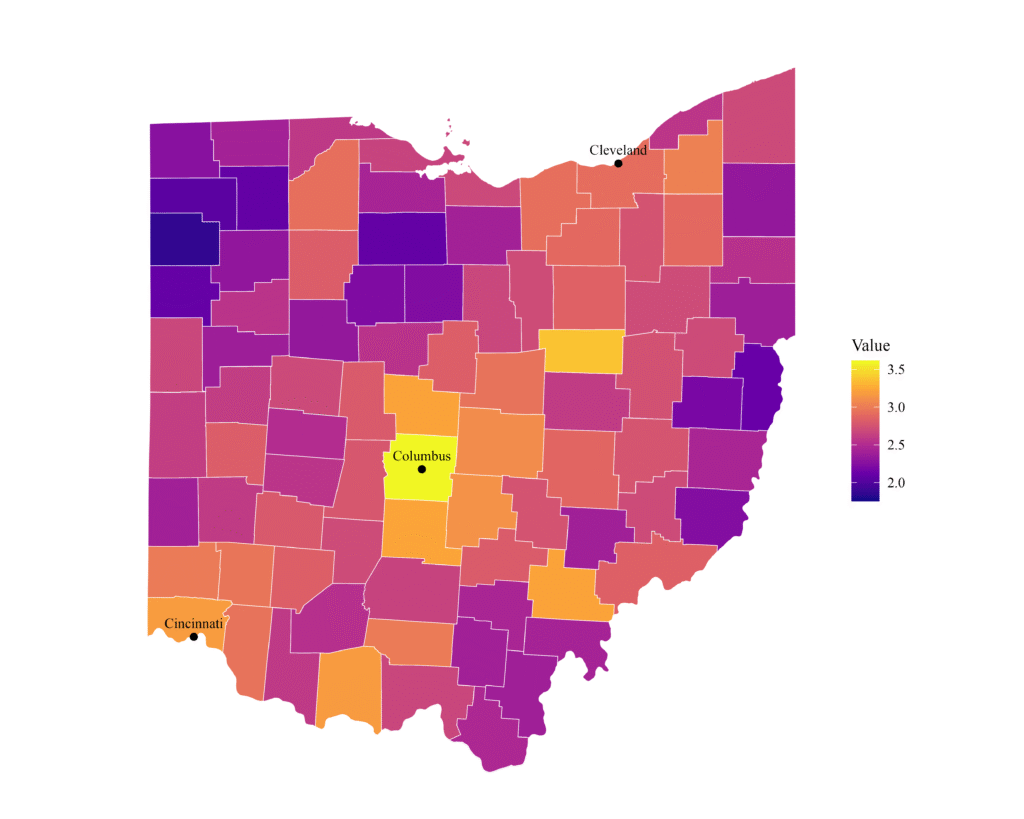
Franklin County stands out on the map, shaded bright yellow near the center of Ohio. Home to Columbus—the state’s most populated city—it has a housing affordability index of 3.6. This means that a median-priced home costs 3.6 times the median household income. If an average household saves 20% of its annual income, it will require 18 years to purchase a house outright in Franklin County without considering inflation and other factors. Yet, apart from Franklin County, it remains challenging to locate the other major metropolitan areas—Cleveland in Cuyahoga County and Cincinnati in Hamilton County—simply by observing the affordability index.
The chart below shows trends over time in Cuyahoga County (Clevealand) and Franklin County (Columbus) over time, breaking down of the affordability index into its two components: median home value and household income. During the 2010s and before the pandemic, the median household value and income for both Cuyahoga and Franklin counties remained relatively stable. However, during the pandemic, both counties’ median home values increased. Ultimately, the growth in median home values outpaces the increase in wages. In addition, the pandemic saw a rapid rise in housing prices within Franklin County than in Cuyahoga County.
Median Incomes and Home Values in Franklin and Cuyahoga Counties
Rising prices, not incomes, are driving unaffordability in Franklin County
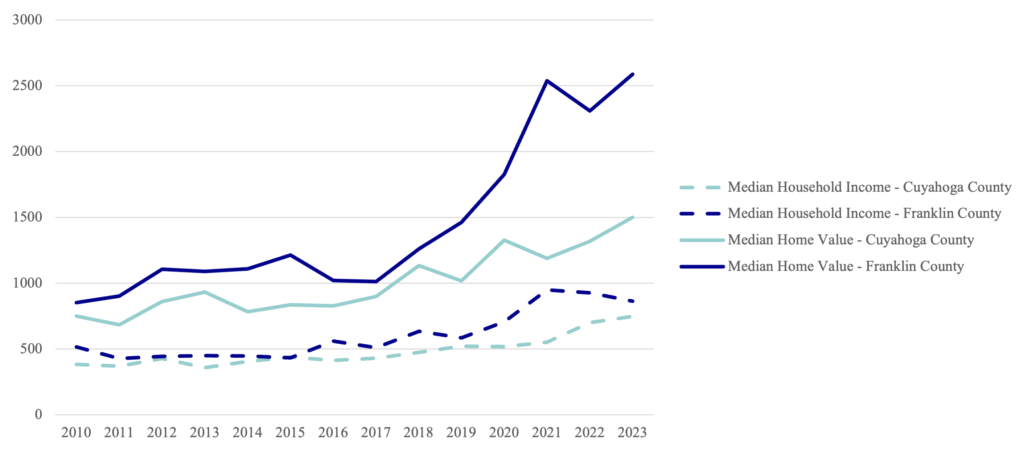
This suggests that Franklin County’s high affordability index (unaffordable) is driven by rising home values, not falling income.
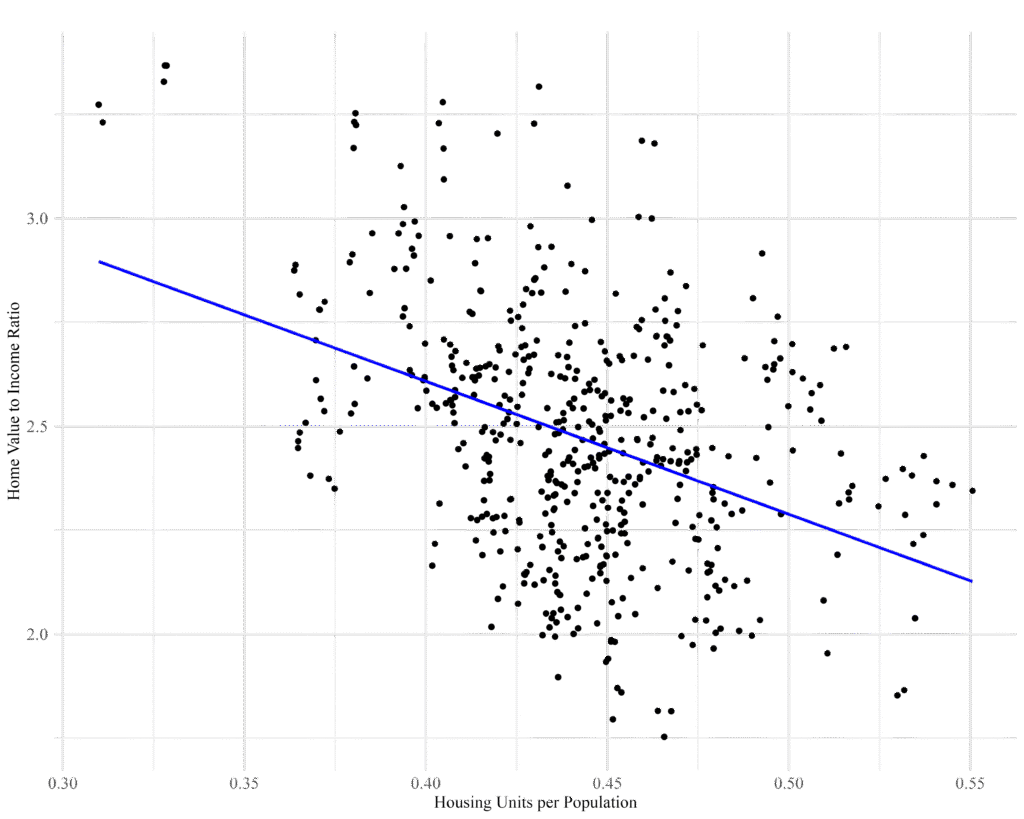
Apart from understanding the simple increase in prices, it is worthwhile examining the theory behind the supply and demand within Ohio’s housing market. Investigating whether the basic model of supply and demand holds within the housing market in Ohio, the chart below compares the affordability index against housing units per population for every Ohio County in each year from 2018-2023. Housing units are the supply, while population is a proxy for housing demand. Each dot on the graph represents a county in a specific year, with outliers removed using the Z-score method. (A threshold of 3 is applied, meaning that data points with a Z-score larger than 3 or smaller than -3 were omitted.) A negative correlation is observed throughout the 6 years covered; as the number of housing units per population in a county increases, the county becomes more affordable. This suggests that the law of supply and demand applies: a higher housing supply relative to housing demand is related to lower prices.
Affordability Index by Housing Units per Population
Counties with more housing units per person have more affordable housing
Upon a close examination of the population change (demand) with the change in housing units (supply) of the same period (2018 to 2023), there exists a strong positive correlation between the two variables shown in Figure 4 (one data point represents one county over the 5-year time period). This suggests that the increase in new housing has in fact been keeping up with the change in demand across Ohio, assuming population size is a reasonable proxy for demand. To some extent, this seems to contradict the growing housing affordability crisis.
Change in Population by Change in Housing Units, Ohio Counties 2018-2023
Changes in population closely predict changes in housing stock
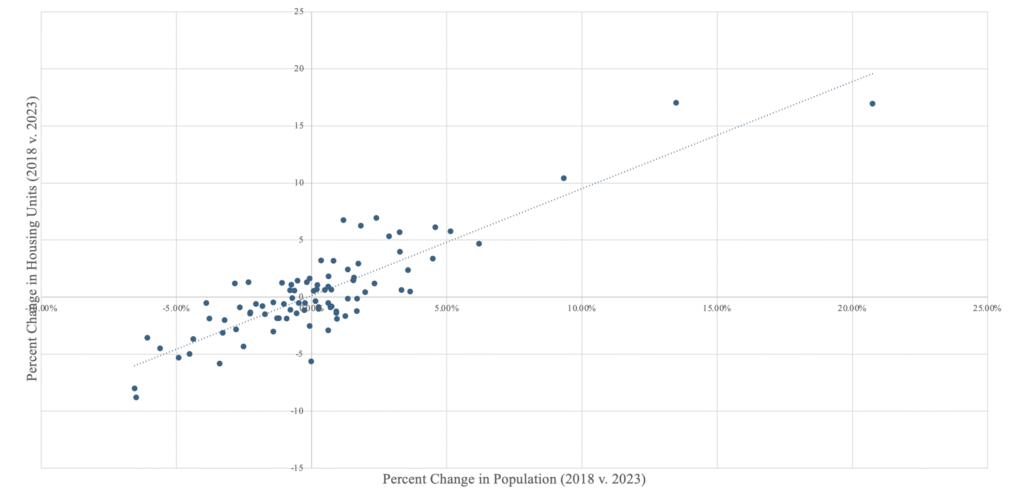
From the data, two potential explanations can be used to explain the mismatch between the last two charts. From the perspective of demand, the Ohio’s housing market may involve a certain number of external buyers or speculators who do not reside in the state, causing the population data to understate the demand in the market. On the other hand, relating the findings to the supply side, the difference could be caused by how newly completed housing units do not cater to buyers within the affordable market. These factors collectively contribute to the growing housing affordability crisis.
The supply and demand model provides a preliminary explanation of Ohio’s housing market, but it is insufficient in fully illustrating the affordability crisis. By further understanding the unique local economic and geographical differences and changes over time, the government could implement regional-specific policies to tackle the crisis.
Featured image by Eathan Hood on Pexels