

Cleveland’s Opportunity Corridor, a newly completed five-lane boulevard, cuts through the city’s impoverished and underdeveloped eastern inner core. Stretching 3.5 miles from an interchange with I-490 and I-77 southeast of downtown, the road winds northeast to University Circle and the Cleveland Clinic’s main campus.
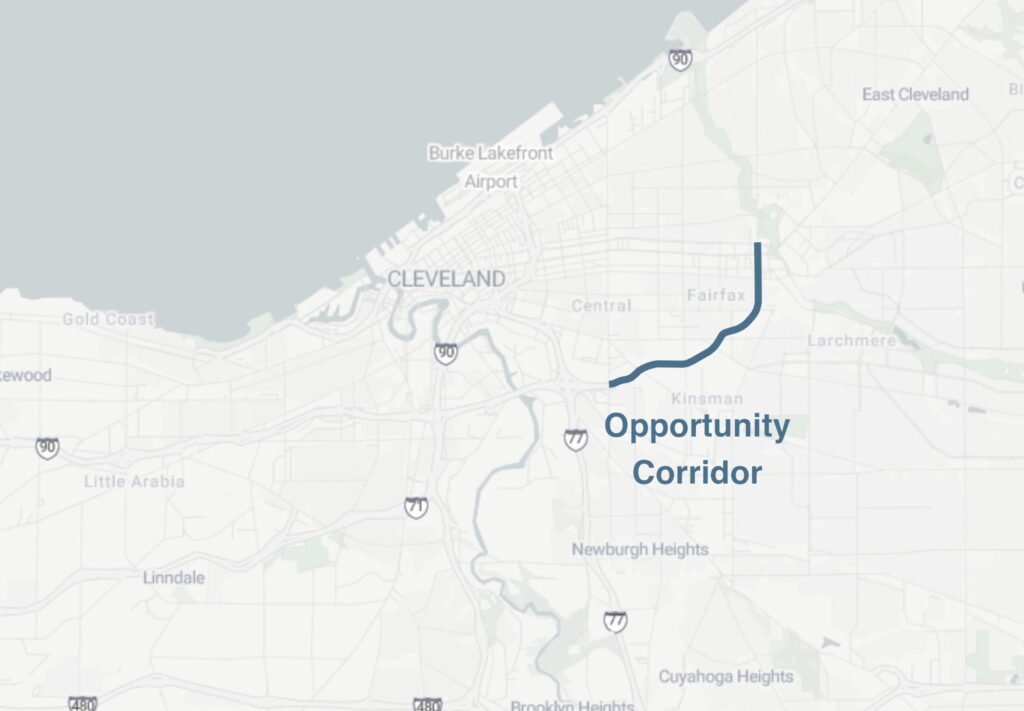
Initially conceived as a limited-access freeway, the road was built as a full-access urban boulevard aimed at neighborhood revitalization. Its stated goals, according to the Ohio Department of Transportation, include “improving the roadway network within a historically underserved, economically depressed area” and “supporting planned economic development”. Construction began in 2015 and was completed in 2021 at a total cost of $330 million.
The Corridor’s completion has stirred mixed reactions: supporters highlight reduced travel times and business growth along its route, while critics question the equity of its economic impact, arguing that the road primarily serves to improve highway access for affluent employees and residents of University Circle, according to local news articles.
Background
The Opportunity Corridor runs through some of Cleveland’s most economically depressed areas. According to American Community Survey (ACS) 5-year estimates, in the five years leading up to the completion of the Corridor’s first stage, the census tracts along its route were among the areas with the lowest median household incomes and highest unemployment rates in both Cleveland and Cuyahoga County. Typical household incomes were around $20,000, below the 2015 poverty level for a 4-person household, and unemployment exceeded 25% in most adjacent census tracts.
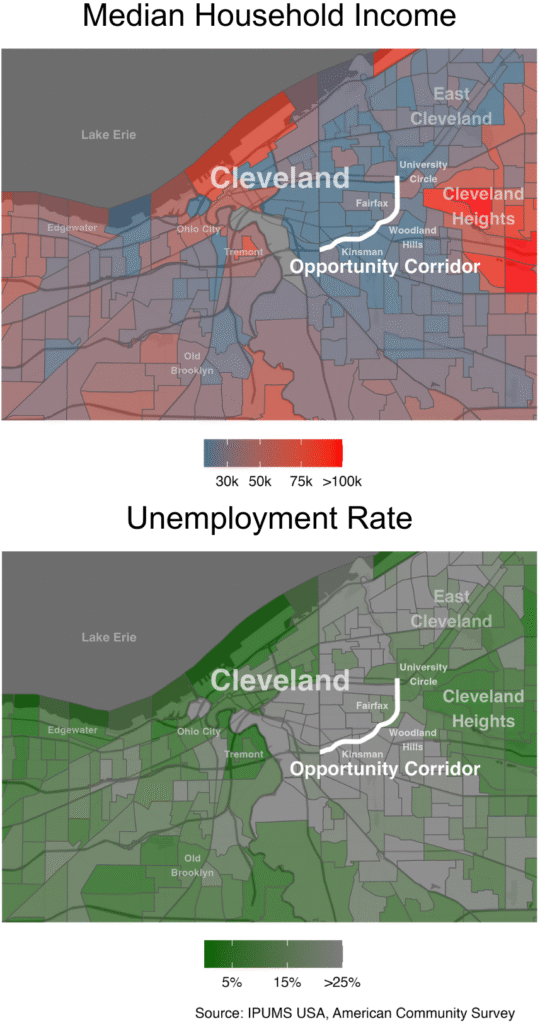
Median Household Income and Unemployment, ACS 5-year estimate for 2013-2017
Proponents of the Corridor have argued that the new road offers a twofold benefit: cutting travel times for those commuting to and from University Circle and spurring economic development in the struggling neighborhoods it traverses. A key piece of this vision lies in fostering business growth along the Corridor itself.
“The Opportunity Corridor has 10-plus acre sites that can be assembled if a company wants to come in. There’s a lack of these in the city,” said Jeff Epstein, Cleveland’s chief of integrated development in an interview with The Land. The city hopes these sizable parcels of land could attract development and create permanent, good-paying jobs. City planners envision a strategic clustering of healthcare and technology jobs near University Circle, with food production and manufacturing hubs taking root further southwest along the Corridor.
Signs of Improvement
Now that Opportunity Corridor has been open for several years, have economic circumstances in the area changed?
Anecdotal evidence points to some business growth along the Corridor. A WKYC article notes that new developments have sprung up near the Corridor’s northern terminus, including several mixed-rate apartment buildings and a Meijer grocery store, Fairfax Market. Further down the Corridor, Nor-Am Cold Storage, a regional logistics firm, recently opened a $50 million cold storage facility on the corner of Opportunity Corridor and East 75th Street.
Existing businesses have also reported improvements. Across the road from the new cold storage facility, Orlando Baking Company is actively hiring, and CEO John Orlando reports that delivery times have been trimmed and it’s easier for his employees to get to work. Other businesses along the route, including Farm House Foods and Miceli Dairy Products, echo similar sentiments, noting that the new roadway has improved logistics and reduced staff commute times. Still, apart from the Cleveland Clinic neighborhood at the northern end of the Corridor, development along the route remains sparse, with many sections still dominated by vacant lots.
Measuring Early Impacts
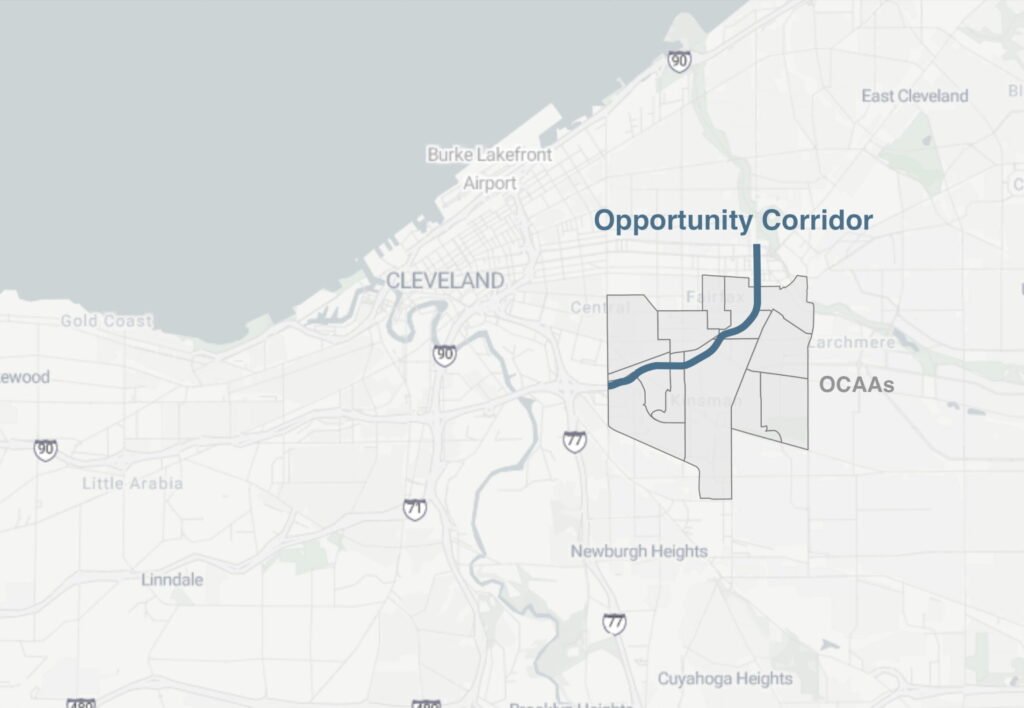
To observe the characteristics of Corridor-adjacent neighborhoods and to measure any immediate local effects of the Corridor, we select census tracts adjacent to the Corridor’s route, which we define as Opportunity Corridor-Adjacent Areas (OCAAs), as shown in Figure 3. These tracts comprise most of the Kinsman, Woodland Hills, and Fairfax neighborhoods.
The data show these neighborhoods to lag in educational attainment and to be reliant on public transportation. OCAA residents were more than three times as likely to take public transportation to work and 10 to 15 percentage points less likely to hold a high school diploma or a degree of higher education than the rest of Cuyahoga County, according to ACS estimates. These data suggest that a new road may not be of the greatest benefit to the local population; poorly educated workers may have limited job opportunities regardless of distance, and a new road is little help for those who commute by public transportation. Still, about 75% of those who worked out of the home commuted to work by car, so it stands to reason that the road could have a positive effect on job access and opportunity.
To identify early trends following the Corridor’s completion, we compare 5-year ACS estimates from before and after the first stage was completed in 2018.
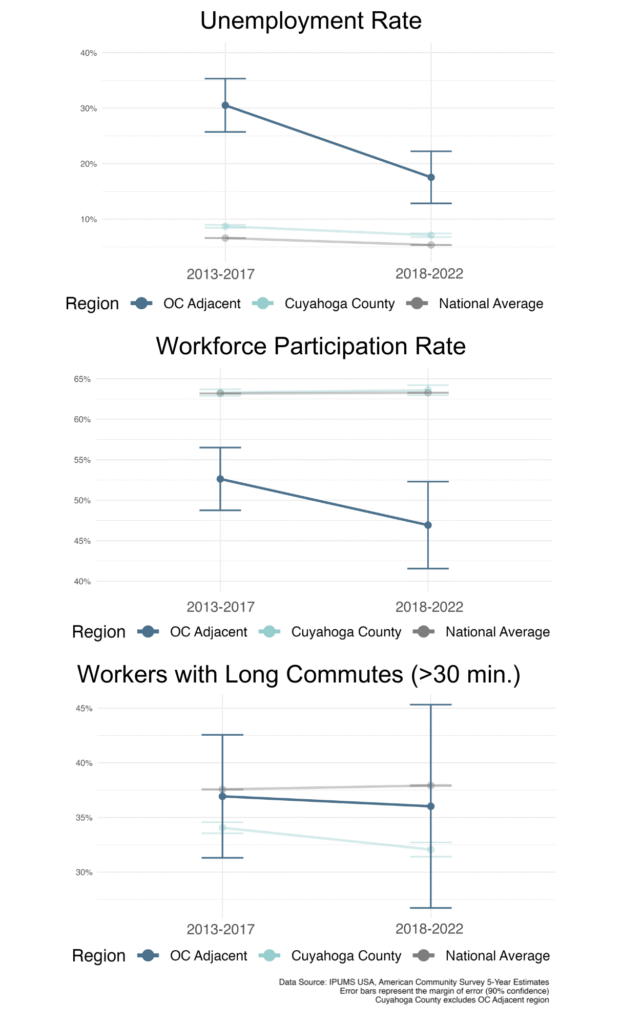
From these comparisons, the evidence is mixed as to whether economic circumstances in OCAAs have improved. We observe a significant decrease in unemployment; the 5-year estimate fell by over a third, from around 30% from 2013-2017 to below 20% from 2018-2022. However, this decrease is similar to what we observe in the rest of Cuyahoga County and the nation as a whole. Further, this fall in unemployment is clouded by a coinciding fall in the estimate for labor force participation rate, a trend that we do not see nationally or in the rest of the county. However, this decrease is within the margin of error, and could just be noise. Finally, there is no significant change in the proportion of workers with long commutes of over 30 minutes.
The fall in unemployment is promising, but when taken with decreasing unemployment nationwide and a persistently low workforce participation rate, these trends do not indicate any significant post-Corridor improvements in economic outcomes.
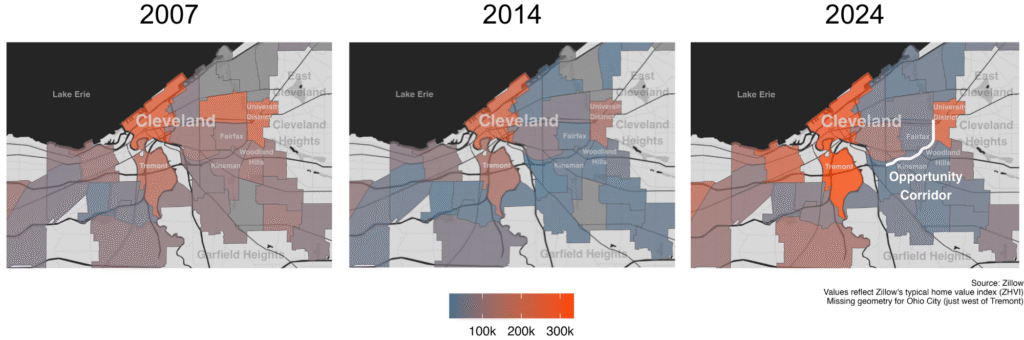
Home values, shown below, reflect the poor economic state of Cleveland’s eastern inner core and show its decline over time relative to the rest of Cleveland. In 2007, home values between Cleveland’s eastern and western core were comparable. Hough, a neighborhood a few miles east of downtown, had among the highest home values in Cleveland. By 2014, the Great Recession had pushed home values down significantly across the city, but there remained relative parity between the east and west sides. In the years that followed, however, home values recovered much faster in western suburbs, while values in the city’s eastern inner core stagnated. Now, neighborhoods adjacent to the Opportunity Corridor, such as Kinsman, Woodland Hills, and Fairfax, have home values much lower than most west-side neighborhoods.
Typical Home Values for Cleveland Neighborhoods
Digging deeper into trends in home values, we see that Pre-Great Recession, Fairfax, Kinsman, and Woodland Hills had home values in the top half of all Cleveland neighborhoods. Now, these neighborhoods are in the bottom fourth. There does not appear to be any bump in home values in these neighborhoods related to the Corridor’s construction start in 2015, first-stage completion in 2018, or final completion in 2021.
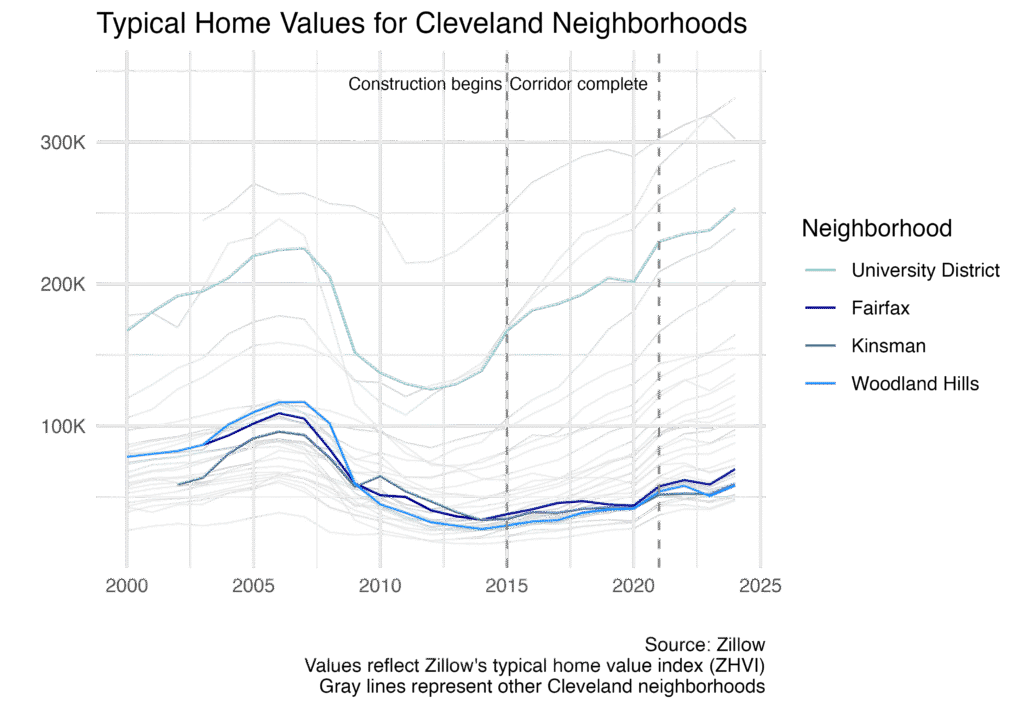
These trends in home values provide further evidence that the Corridor has yet to improve economic circumstances in OCAAs.
Conclusion
The Opportunity Corridor was envisioned as a transformative project to spur economic development and improve mobility in some of Cleveland’s most economically disadvantaged neighborhoods. Early data show some signs of improvement; anecdotally, there exists some new development and business growth along the Corridor, and we observe a significant fall in unemployment in Opportunity Corridor-Adjacent Areas. However, other relevant indicators for these areas — workforce participation rate, home values, and commute times — show no evidence of improvement. Additionally, much of the anecdotally observed business growth and development along the Corridor has been confined to areas around the northeast terminus of the Corridor, near the Cleveland Clinic. In general, it appears that progress in reversing the economic challenges faced by OCAAs further down the Corridor has been limited. Without significant expansion of local, low-skilled job opportunities, the road’s effectiveness may be constrained by the low educational attainment and relatively high reliance on public transportation among residents in OCAAs.
Our observations about the potential early effects of the Corridor are purely correlational. To better estimate the causal effects of the Opportunity Corridor on economic outcomes in Cleveland’s eastern inner core, future research could use econometric techniques such as Difference-in-Differences or Synthetic Control Models. These methods would allow for a more robust analysis of the Corridor’s impact by controlling for confounding factors and isolating the effect of the road.
Featured image by Anas Hinde on Pexels
Sources
- Castele, N. (2020, Feb 13). Mixed feelings as opportunity corridor nears completion. Retrieved from https://www.ideastream.org/community/2020-02-13/mixed-feelings-as-opportunity-corridor-nears-completion
- Opportunity corridor overview. (n.d.). Retrieved from https://www.transportation.ohio.gov/projects/mega-projects/resources/oc/oc-overview
- Shookman, S. (2021, Nov 10). Cleveland businesses share mixed emotions as opportunity corridor gets set to open. Retrieved from https://www.wkyc.com/article/news/local/cleveland/cleveland-businesses-share-mixed-emotions-opportunity-corridor-prepares-open/95-3747a267-499d-422d-9bbc-9e6fc18a6a02
- Williams, R., & Chilcote, L. (2023, May 2). Despite empty land, companies see improvements along opportunity corridor, with promises of more to come. The Land. Retrieved from https://thelandcle.org/stories/despite-empty-land-companies-see-improvements-along-opportunity-corridor-with-promises-of-more-to-come/