When the U.S. government announced plans for student-loan forgiveness in August 2022, many expected spending to rise, consistent with evidence that increases in liquidity can boost household consumption . The intuition was simply if households expect lower future payments, they may feel more comfortable spending. In practice, though, it seems there is little evidence of a stronger spending response in high-debt states.
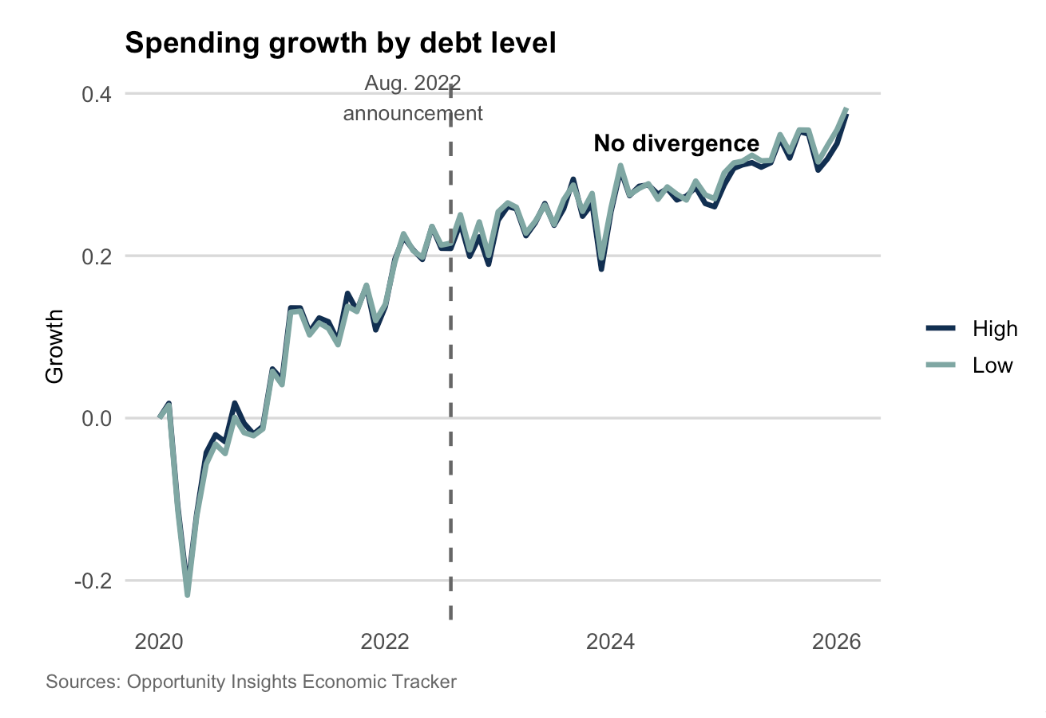
Spending rises after the August 2022 announcement, but high and low-debt states remain closely aligned, with no visible gap opening between them in the months that follow. The increase is shared rather than concentrated in more heavily indebted areas.
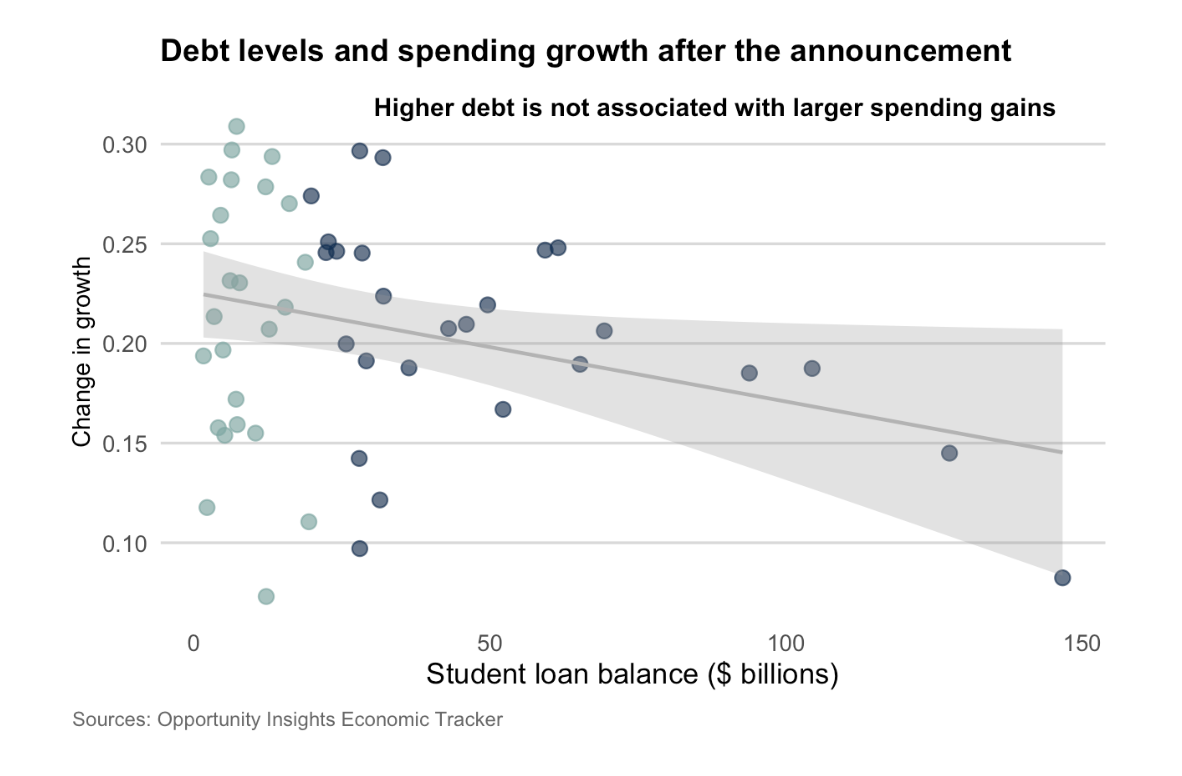
Plotting spending growth against student-loan balances shows no clear pattern. States with higher debt are not clustered at the top of the chart. Instead, the points are spread across the full range of outcomes and tilt slightly downward overall. Larger student-debt burdens are not associated with larger increases in spending.
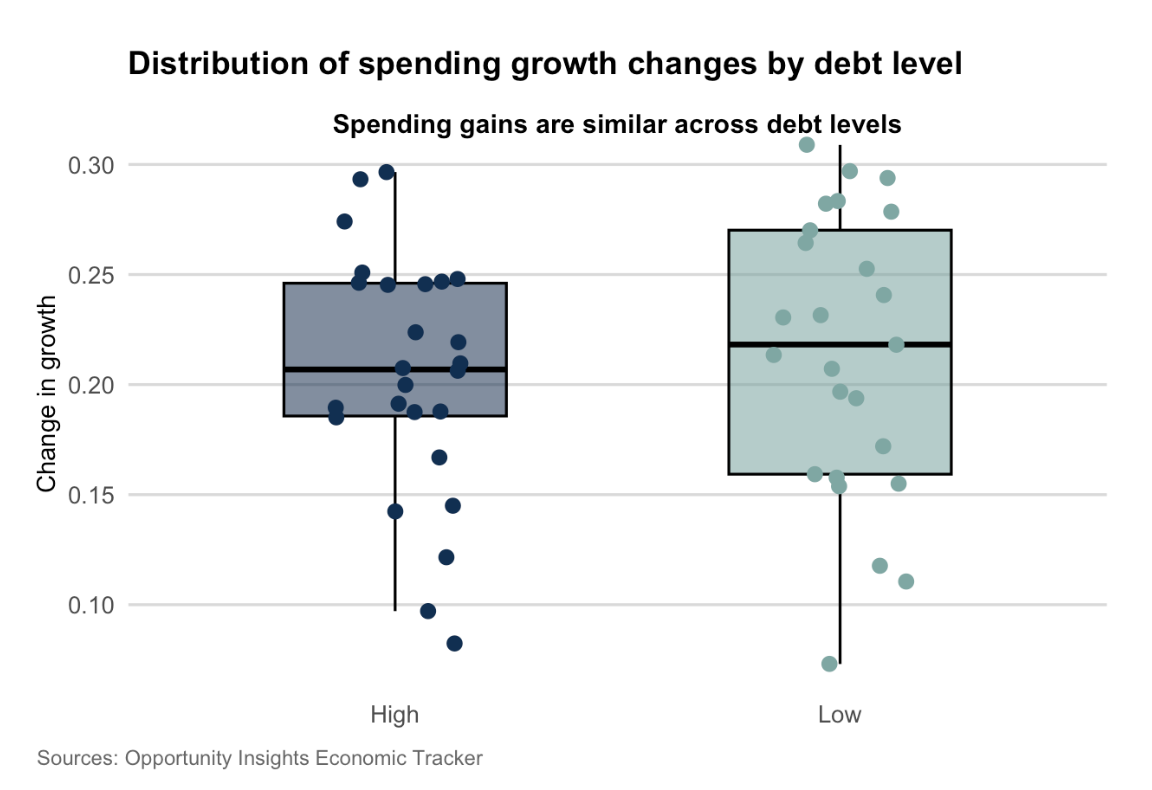
The distributions are very similar across the two groups. Median spending growth is close, and the ranges overlap substantially. Both high- and low-debt states show a wide spread of outcomes, with neither group consistently above the other.
A more convincing explanation is timing. The months after August 2022 coincide with a broader economic rebound, with wages rising and unemployment remaining low. As incomes stabilized and constraints eased, consumption increased in both high- and low-debt states. Those forces likely mattered more for spending than expectations about loan forgiveness.
Uncertainty may also have mattered, as policy uncertainty can dampen behavioral responses . Legal challenges and political debate made it unclear whether forgiveness would actually happen. Without a clear change in payments, households had little reason to adjust their behavior.
Overall, the pattern is straightforward. The rise in spending after 2022 looks more like part of the economic recovery than a response to the policy announcement. Student-debt relief may shape expectations, but it does not appear to have meaningfully changed spending in the short run.