The Economy Moves. The Music Doesn’t.
Popular wisdom has long held that hard times make for sad songs. When jobs disappear and markets fall, so the story goes, listeners reach for melancholy ballads; when confidence rebounds, the dancefloor fills. The intuition is tidy, culturally resonant, and, according to a systematic analysis of Billboard Hot 100 chart data matched against six macroeconomic indicators, almost entirely wrong.
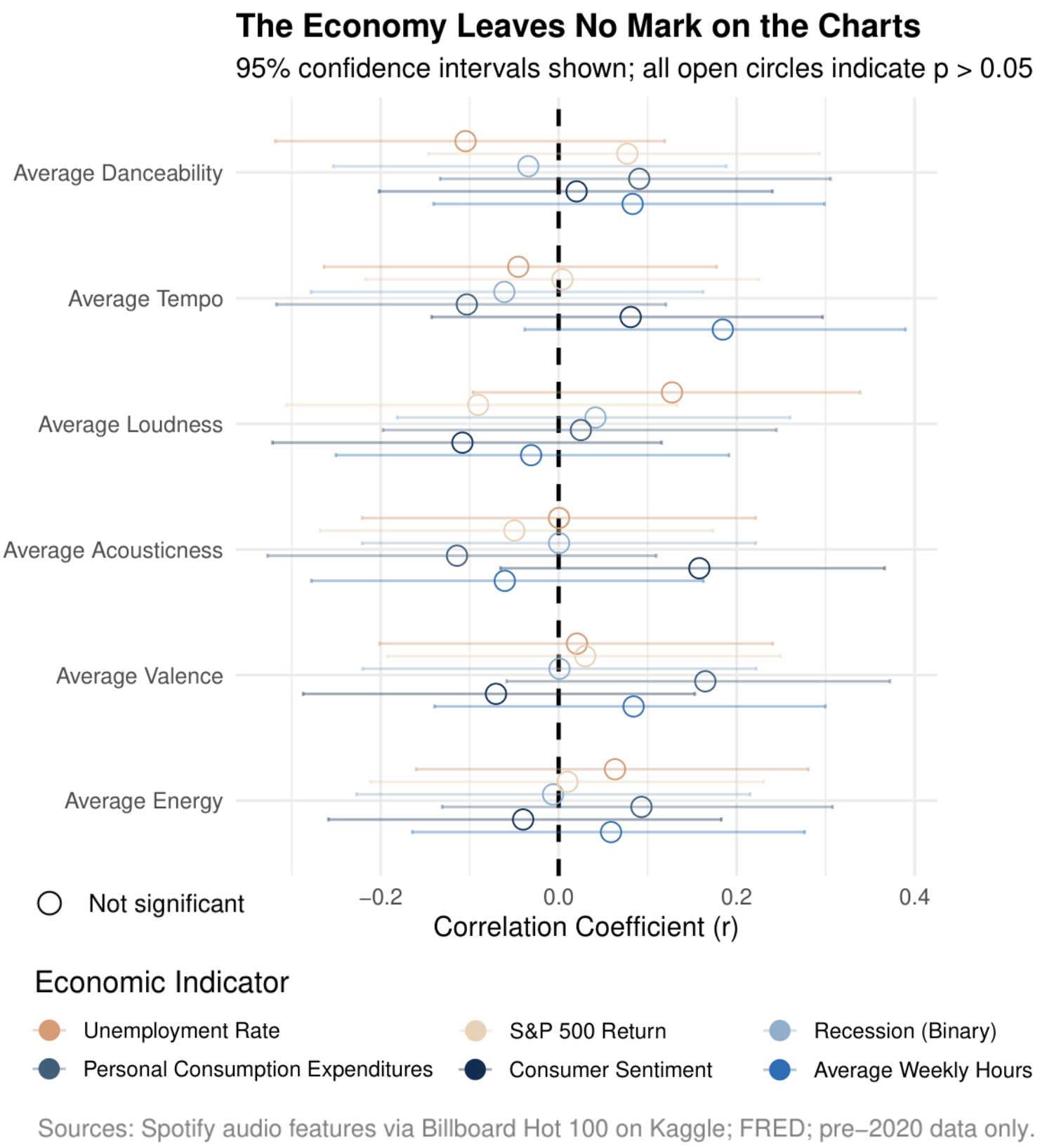
From 2000 to 2019, quarter-over-quarter swings in unemployment, consumer sentiment, spending, working hours, stockmarket returns and recession status have no discernible relationship with shifts in the valence, tempo, danceability, loudness, energy or acousticness of hit songs. Not a single pair produces a statistically significant correlation.
The breadth of that null result is striking. Every confidence interval in the dot plot crosses zero. The correlation coefficients range from -0.15 to +0.18, and most cluster closer to the center than the extremes. There is no clear pattern of direction: some economic indicators associate weakly positively with a given music feature, others weakly negatively, with no consistency that would survive scrutiny. The chart does not look like a weak signal buried in noise. It looks like noise.
The Most Intuitive Case Fails Most Visibly
Of all possible pairings, consumer sentiment and musical valence seem to be a likely high-correlation duo. Both measure something like collective mood: one through survey responses about household finances, the other through an algorithmic score of how ‘happy’ or ‘positive’ a song sounds. Mood-congruence theory, well-established in the psychology literature, predicts that people select music that reflects or reinforces their emotional state. If aggregate economic sentiment shapes aggregate musical taste, this is where the signal should appear.
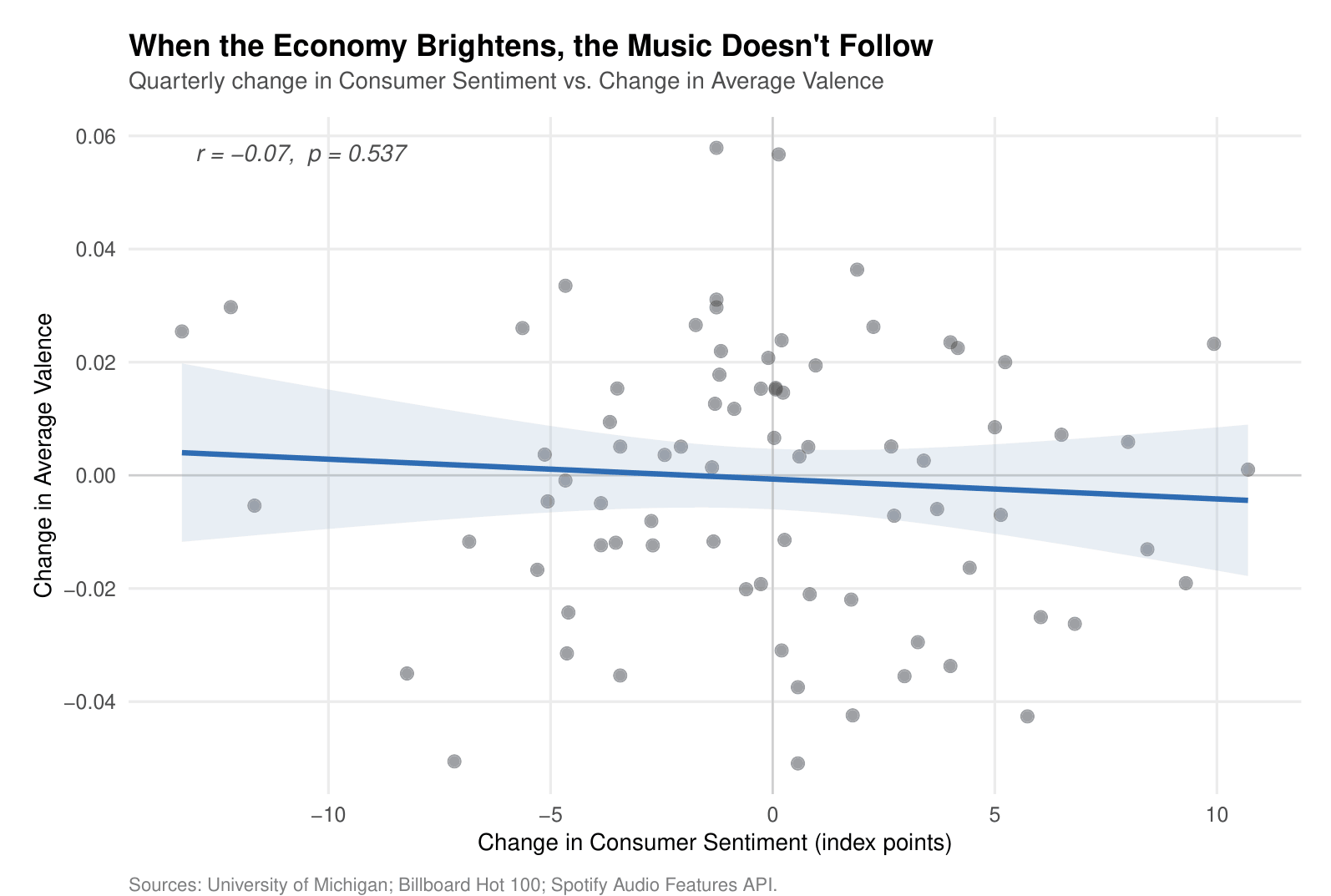
It does not. The slope of the best-fit line is not merely flat but slightly negative (r=-0.07, p=0.537): as consumer sentiment improved quarter over quarter, the valence of chart hits nudged marginally downward. The effect is far too small and statistically uncertain to treat as a real finding, but it runs in the wrong direction for the conventional story of music tastes lifting with economic mood. The confidence band swallows any plausible slope.
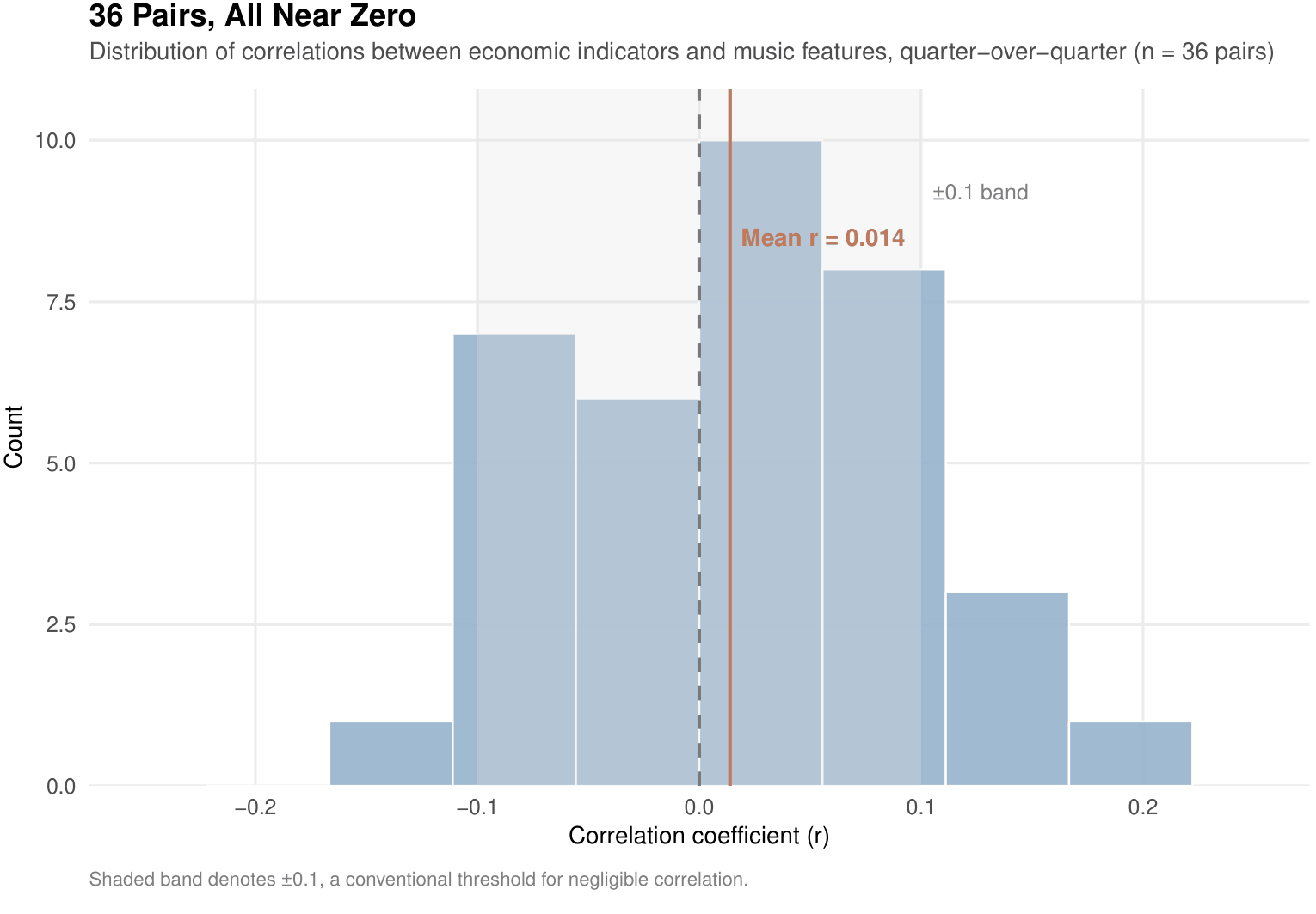
Zooming out from any single pair confirms the picture. The distribution of all 36 correlation coefficients has a mean of just 0.014 – indistinguishable from zero. The vast majority of values fall within the ±0.1 band conventionally regarded as negligible. The distribution is not skewed toward positive correlations (as one might expect if a general ‘economic mood’ were leaking into musical taste), nor toward negative ones. It is simply centered on nothing.
The Silence Holds Across Time
One natural objection to the contemporaneous analysis is that cultural responses to economic conditions may take time to materialize. A recession that begins in one quarter may not register in the charts until artists have had time to write, record, and release music that reflects it, or until listeners have had time to seek it out. Cross-correlations across 12 quarters (3 years) in each direction capture relationships whether the economy moves first and the music follows, or the reverse.
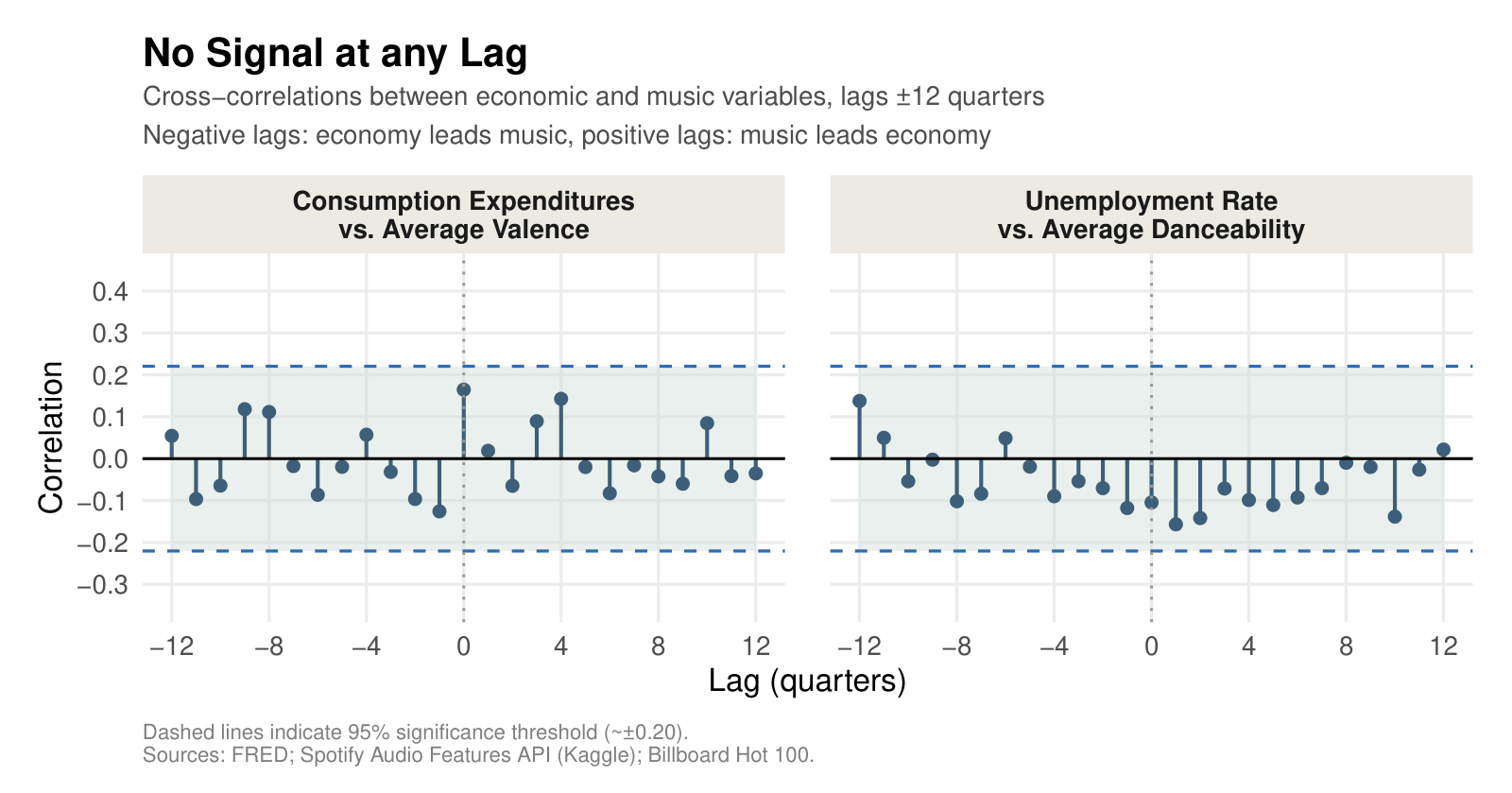
The result is the same. No lag structure produces a correlation that approaches statistical significance. The bars in each panel stay within the shaded confidence band regardless of whether the economic variable leads or follows the musical one. If there is a cultural echo of economic conditions somewhere in the charts, it does not operate on a timescale this analysis can detect.
Why the Charts Might Not Care
Several explanations come to mind, none mutually exclusive. The most structural is that Billboard chart performance reflects industry gatekeeping—label decisions, radio programming, and promotional cycles—as much as it does listener preference. What reaches the top of the charts in any given quarter may say more about release schedules than about how Americans are feeling about their finances.
A second possibility is that aggregate taste masks heterogeneous individual responses. People may well reach for sadder music during recessions; but others reach for escapist anthems. Averaged across millions of listeners and dozens of chart positions, these individual responses cancel each other out, leaving the aggregate signal flat.
A third possibility is that mood-congruence theory is real, but people’s emotional lives are shaped more by intimate and immediate experiences than by the broader economy. Even if listeners choose music that fits their mood, that mood may reflect relationships, work, health or personal stress more than unemployment rates or consumer sentiment.
A final, harder-to-dismiss explanation is one of timescale. The analysis runs on quarterly data over roughly 19 years. The relationship between economic conditions and musical culture may be real but slow-moving—visible across decades, as rock gave way to disco during the inflationary 1970s, or as the post-2008 era produced a notable turn toward introspective hip-hop, rather than detectable quarter by quarter. If so, this analysis would correctly find nothing, and evidence for the conventional wisdom would require only a temporal correction, not a refutation.
What the data do refute, cleanly, is the quarter-by-quarter version of the mood-ring theory: the idea that the Billboard charts track short-term economic changes with any meaningful accuracy is not supported. The economy may move, but the music, at least in the short run, does not follow.
Methodology: Monthly data were aggregated to quarterly averages and analyzed as quarter-over-quarter changes. Audio features were sourced from the Spotify API via a Billboard Hot 100 dataset on Kaggle. Economic data were sourced from FRED (Federal Reserve Bank of St. Louis). Analysis covers the period from the early 2000s through the end of 2019; data from 2020 onward were excluded to avoid distortions from the covid-19 pandemic. Significance testing used two-tailed Pearson correlation tests with Benjamini-Hochberg false discovery rate correction across all 36 pairs.
Audio features: Spotify’s valence score rates songs from 0 (most negative) to 1 (most positive). Danceability, energy, and acousticness are similarly normalized algorithmic proxies; they are imperfect but consistently applied measures of musical character.