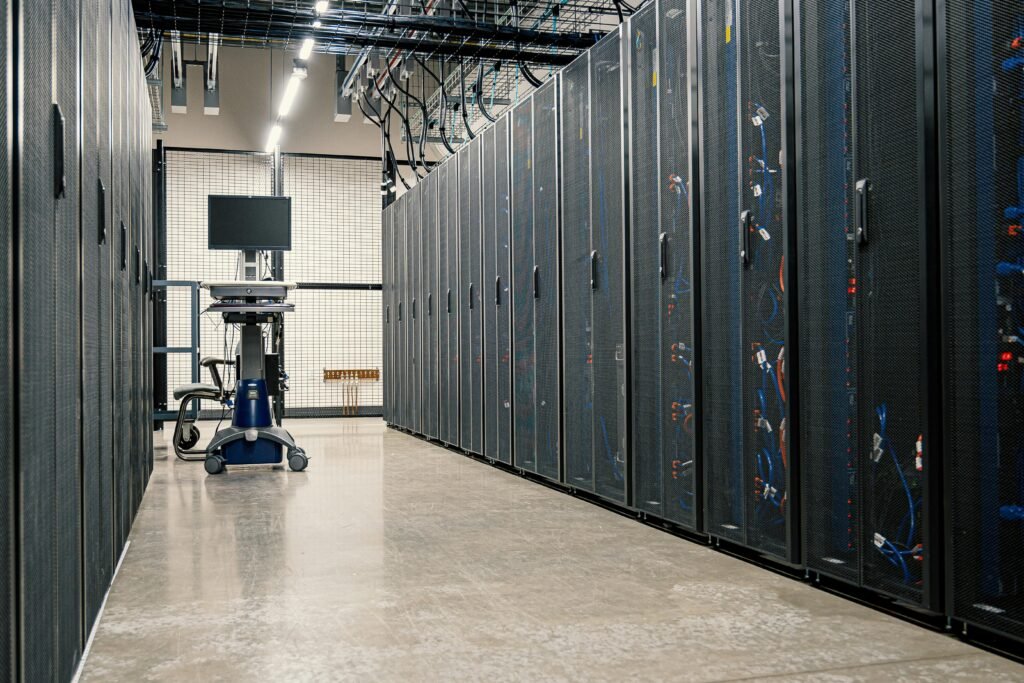
When you think of the center of the digital world, one’s mind is quickly drawn to Silicon Valley. Yet, that title arguably belongs to the third most populous county in Virginia. Loudoun County boasts the largest concentration of data centers in the world, handling roughly 75% of the world’s internet traffic through what the industry has come to call “Data Center Alley”. As AI services and large language models have exploded in popularity and show no signs of slowing down, the demand for data centers has skyrocketed. These data centers require an immense supply of power to function, and most of these massive billion dollar facilities draw power from the same electrical grid that powers your home. With this exponential increase in electricity demand, utility companies in data center hotspots must respond. Utility companies are investing record amounts, but how closely does that investment actually track the demand for power, and who ends up picking up the bill?
Mapping the Investment
Capital expenditures for the primary utility in 5 states with high data center concentrations grew significantly over the last decade, especially since 2021. 1
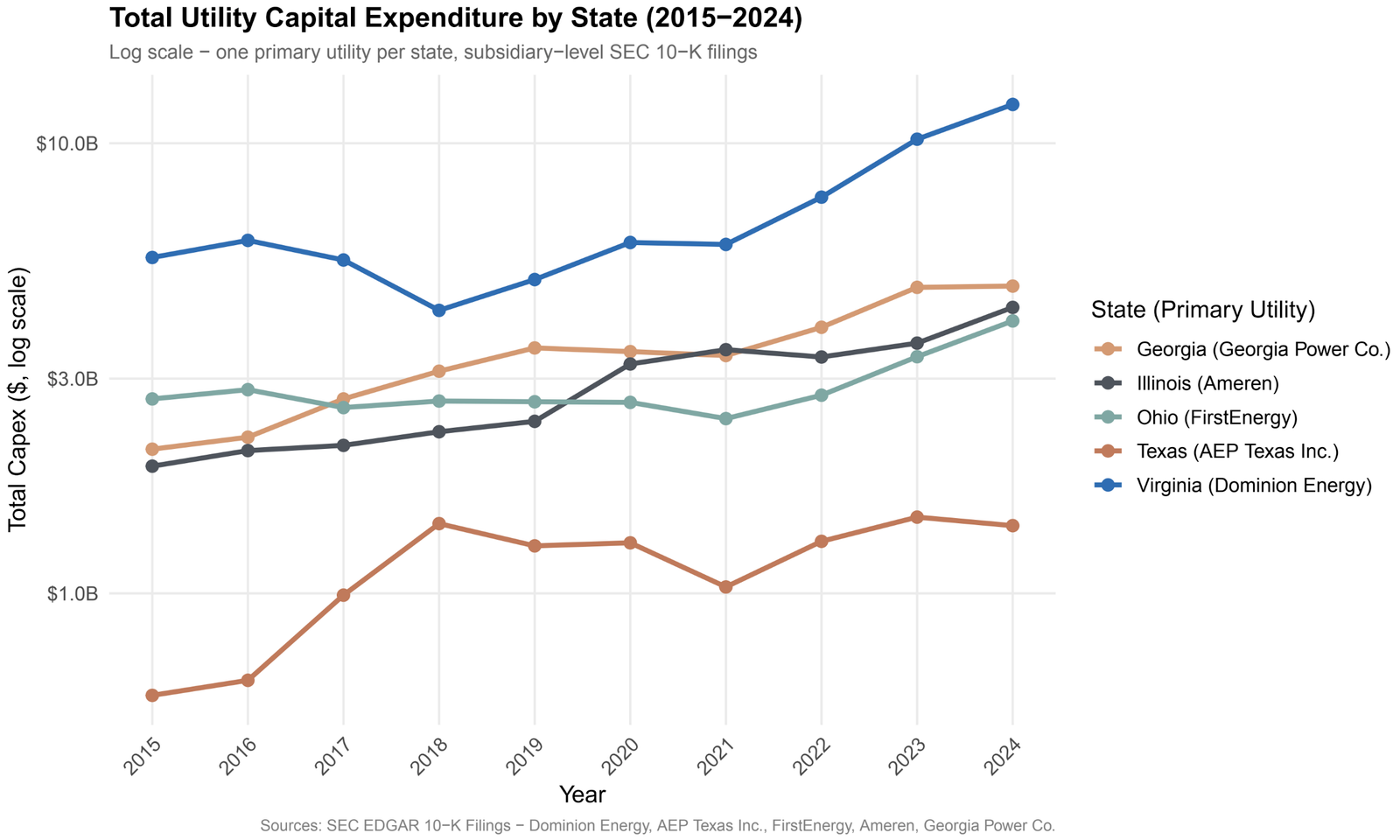
While Georgia Power Co. in Georgia, FirstEnergy in Ohio, and Ameren in Illinois maintained consistent growth from 2015 to 2024, Dominion Energy in Virginia emerges as a clear outlier. Dominion Energy’s annual capital expenditures skyrocketed from billion in 2015 to billion in 2024; a significant 119% increase over the period. Furthermore, most of this growth occurred between 2020 and 2024, with spending more than doubling from roughly billion to billion in 2024. This trajectory is likely reflective of Northern Virginia’s tax exemptions that grant tax relief on data center equipment. These incentives have spurred rapid construction as data center operators and hyperscalers flocked to the region to capitalize on these exemptions.
The Demand Side
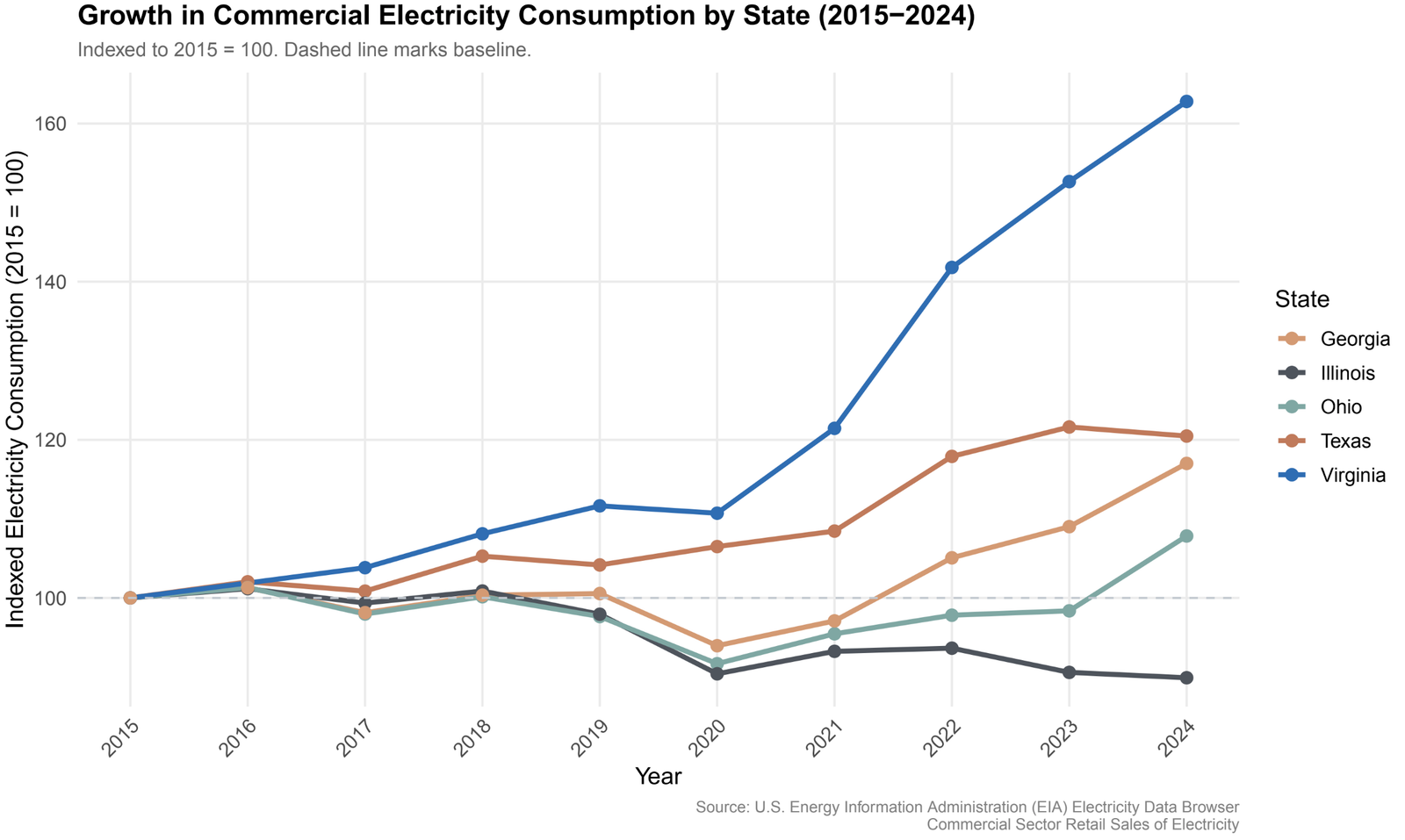
Commercial electricity consumption has also increased significantly, with Virginia dominating the rest of the group, seeing close to 60% growth in commercial electricity demand over the period. Notably, the period with the most growth occurred between 2020 and 2024. Texas, Georgia, and Ohio see a similar, albeit less dramatic, trend, while consumption in Illinois has actually declined.
Boom or Bubble?
Over the last several years, it appears that growth in utility capital expenditures has far outpaced growth in actual electricity consumption. Across these five states and during the 2015-2024 time period, capital expenditures grew by an average of 112.3%, while commercial electricity demand grew by an average of only 19.6%. This suggests that utility companies are investing far ahead of what current demand reflects, essentially betting that AI continues to find a larger foothold in society. If the AI boom continues to grow, these investments will be justified. If the AI boom cools off, utility companies are left with billions of stranded assets. This bet carries real stakes, some of which are already being shifted onto the general public. If these assets aren’t met with the expected demand, utilities might be forced to raise rates on the average consumer to ensure continued operations. This trend has already surfaced in Virginia, as Dominion Energy has already implemented rate hikes, forcing the average consumer to pay an additional per month to cover Dominion’s bet on AI growth (Virginia State Corporation Commission 2025). It seems that AI is here to stay, and for the average electricity consumer, the true cost of AI is just beginning to show up on their monthly statements.
-
The capital expenditures chart uses a logarithmic y-axis. Equal vertical distances represent equal percentage changes in capital expenditure rather than equal absolute dollar increases.↩︎