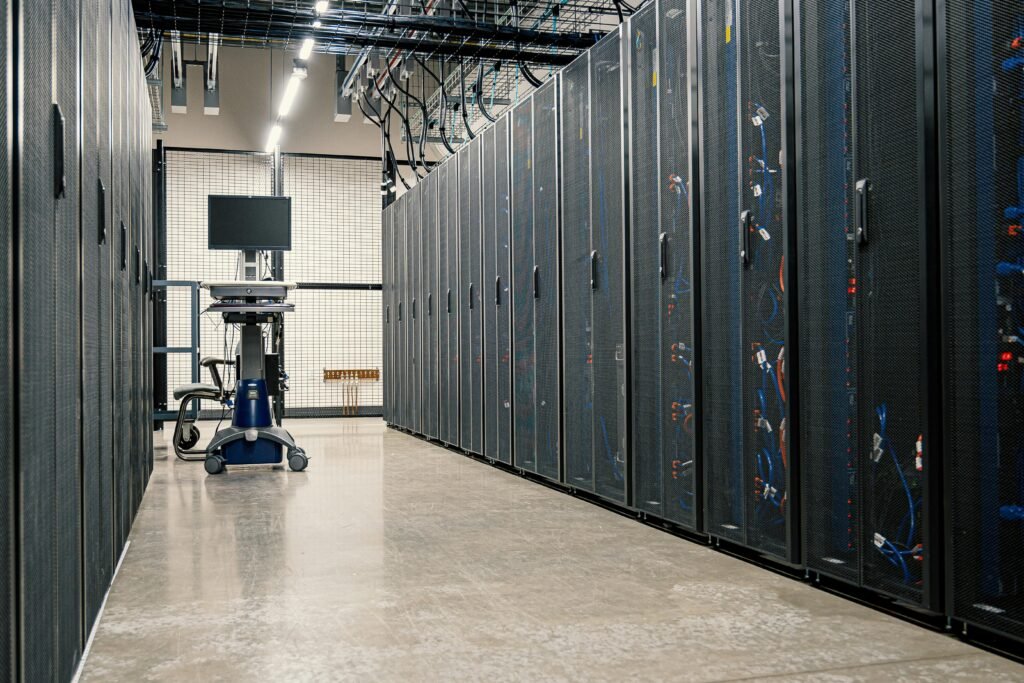
Ashburn, Virginia, an affluent outer suburb of Washington, DC, is known for highly rated public schools and high household incomes. It’s also home to the world’s largest concentration of data centers—massive warehouses full of computers that support online services like cloud computing, streaming platforms, and, increasingly, artificial intelligence systems. Those facilities require enormous amounts of electricity, a feature that has made them a hot topic from national politics to local Facebook groups and that raises the question: who bears the cost of the power they consume? It’s complicated, but Virginia households may already be seeing this “hidden tax” showing up on their utility bills. A typical Virginia household using 1,100 kilowatt-hours per month now pays about a month for electricity; that’s about , or 33%, more than in January 2022 (U.S. Energy Information Administration 2026).
The U.S. alone holds roughly 45% of global data center capacity (JLL 2026). Some of the largest concentrations of data centers in the U.S. are in Northern Virginia, Georgia, and Texas. New development tends to be focused on the South, Midwest, and Great Plains, while the Northeast and West Coast show comparatively less new construction in this dataset.
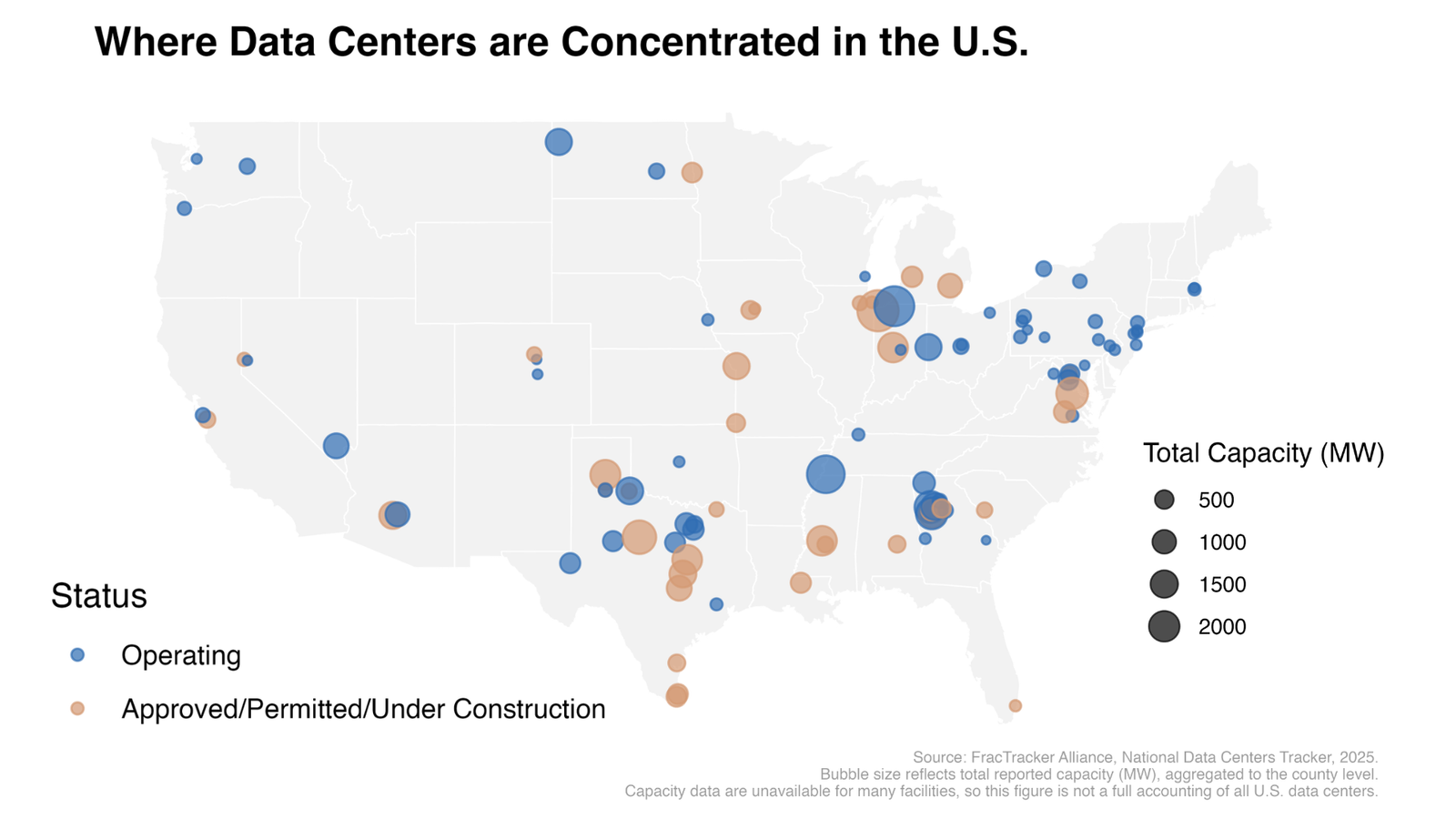
These massive data centers operate continuously and require extensive cooling infrastructure, establishing them as one of the fastest-growing drivers of power consumption in the country (U.S. Department of Energy 2024). As the U.S. undergoes an unprecedented build-out of data center infrastructure to support the development and adoption of AI, policy makers and utility providers have raised concerns about upward pressure on electricity prices.
Since ChatGPT’s launch in late 2022, electricity prices have grown faster in states with higher counts of data centers per capita after trending similarly beforehand. Interestingly, prices have grown fastest in medium-exposure states, while prices in high-exposure states have trended similarly to those in low-exposure states.
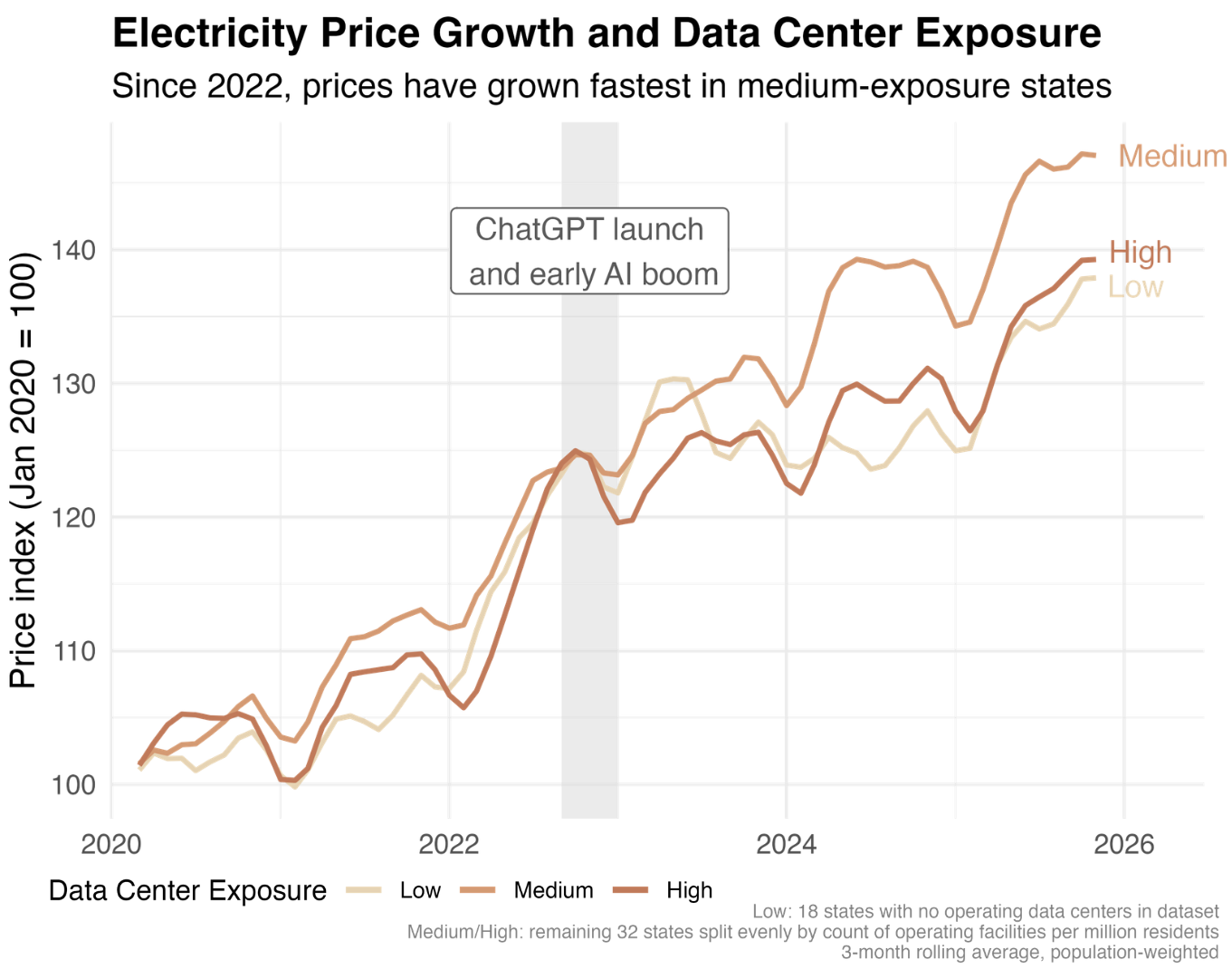
The similar pre-2022 trends make it harder to argue that the divergence simply reflects long-running differences between the groups. They do not, however, rule out shocks that emerged around 2022 and landed unevenly across them. It should also be noted that electricity markets are regionally interconnected, and price dynamics depend not only on demand but also on generation mix, transmission capacity, and regulatory structures (Belfer Center for Science and International Affairs 2026). Whether consumers are truly bearing a hidden cost, or if broader grids are simply absorbing it, is not always clear.
Zoom in, and the story gets complicated.
If data centers were driving electricity prices up uniformly across high-exposure states, you would expect every high-exposure state to show prices surging well above the national average. But that is not what the data shows. Texas, consistently one of the largest data center markets in the country, has instead tracked very closely the national average since 2022.
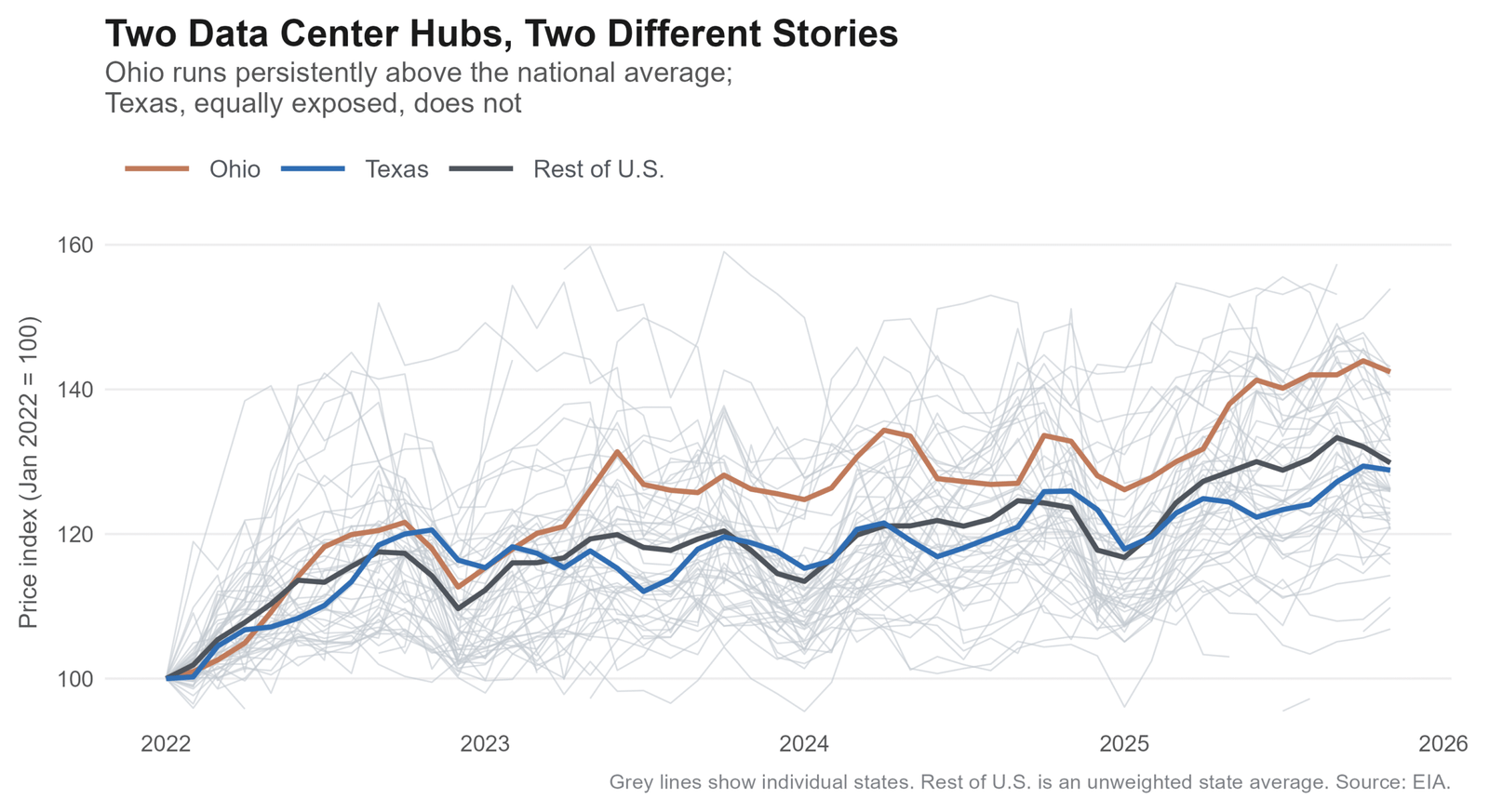
This may be in part due to the structure of its independent ERCOT grid, which operates outside the interstate transmission system that governs most of the United States, insulating it from broader regional pressures (Texas Comptroller of Public Accounts 2023). Indeed, the regional grid appears to absorb local demand shocks rather than solely passing costs down to residents.
Ohio tells an opposite story. Despite sitting in the same high-exposure tier as Texas, Ohio’s electricity prices have run far above the national average since 2022—grwoth has been 8 percentage points higher than the rest of the country since the start of the ChatGPT era. Unlike Texas, Ohio sits inside PJM, a multi-state grid that has passed billion in Ohio transmission upgrade costs directly to ratepayers, which may help explain why Ohio’s electricity prices have risen more sharply(Signal Ohio 2025).
While the connection between data center concentration and higher electricity rates is not universal, the aggregate trend is evident. As AI investment continues to pour into a handful of states, the hidden tax on electricity bills is likely to grow with it.
Data Notes
Residential electricity prices are taken from monthly EIA data, measured in cents per kilowatt-hour at the state level. Different states begin at vastly different baseline price levels, which is why raw prices are transformed into a standardized index. The divergence chart uses population-weighted averages—each state’s price is weighted by its population before averaging across the group, so that larger states count for more and small states do not skew the result.
State exposure groups; based on operating datacenter counts in the FracTracker database:
| Group | States |
|---|---|
| Low (0 data centers) | AK, CT, DE, FL, HI, ID, IL, KS, ME, MN, MT, NH, RI, SD, UT, VT, WV, WY |
| Medium (0.1-0.7 data centers per million residents) | AR, CA, CO, IN, KY, LA, MA, MD, MI, MO, MS, NC, NJ, NY, SC, WI |
| High (0.7-20.7 data centers per million residents) | AL, AZ, GA, IA, ND, NE, NM, NV, OH, OK, OR, PA, TN, TX, VA, WA |