Does education predict sports betting?
Does education predict how much a state bets on sports? After analyzing handle, population, and education data across every legal market in the country, the answer is no. In May, 2018, the Supreme Court struck down the federal ban on sports betting, handing individual states the power to legalize wagering on athletic contests. What followed was rapid expansion. Thirty-five states have since opened their markets, and Americans now wager hundreds of billions of dollars a year on everything from NFL touchdowns to March Madness brackets. As the industry has expanded, natural questions have emerged about who is participating and why. One such question is whether educational attainment at the state level predicts the intensity of sports betting activity, given that education is often associated with how consumers assess risk, process information, and make financial decisions. Handle, the total dollar amount wagered by bettors, serves as the primary measure of betting activity throughout this analysis.
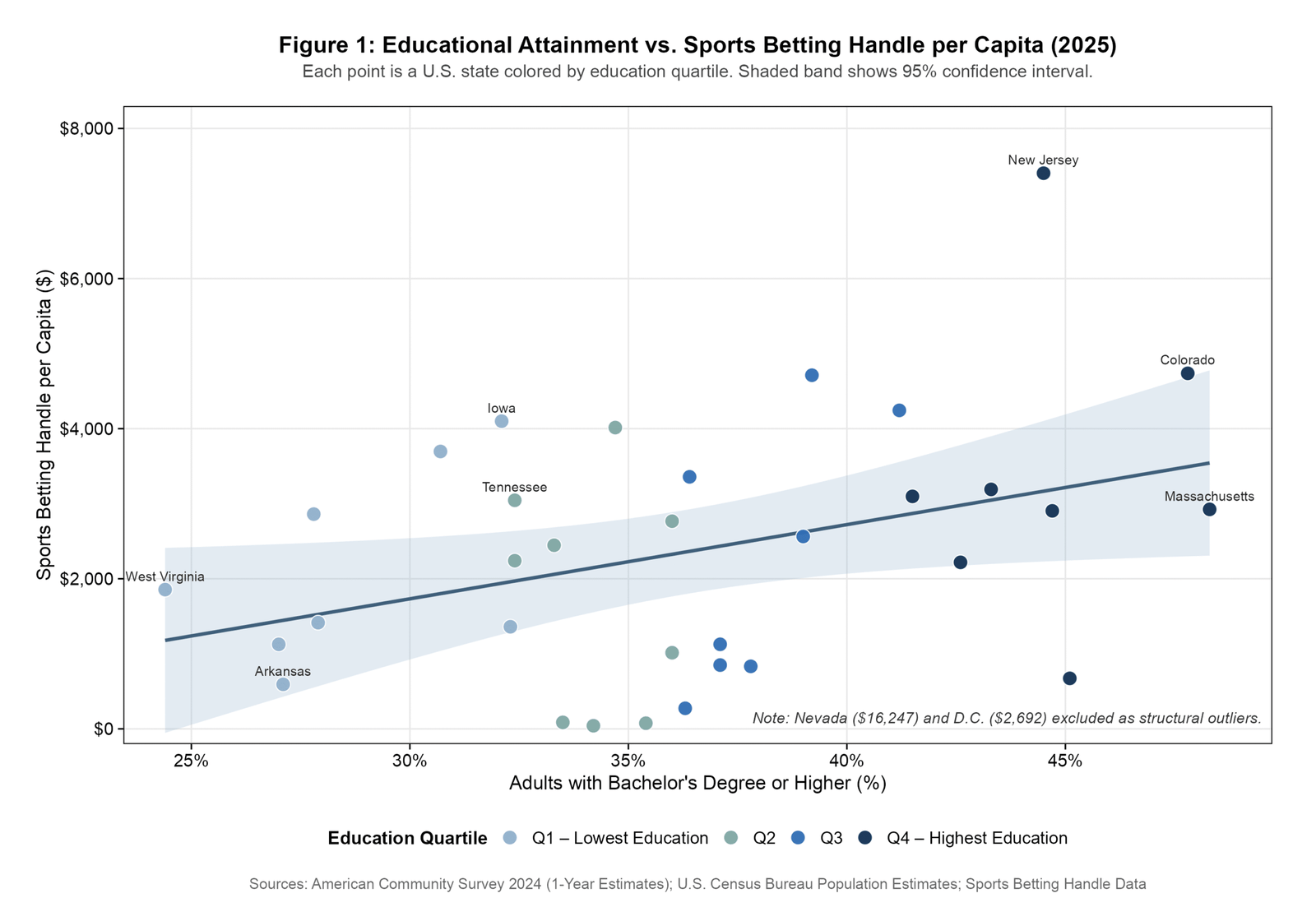
States with the lowest shares of adults holding a bachelor’s degree or higher bet at similar rates to the most educated states in the country.1 The line of best fit slopes gently upward, suggesting, if anything, a slight positive relationship, though the confidence band is wide and the scatter is vast. States ranging from Arkansas, where fewer than 28% of adults hold degrees, to Massachusetts, where nearly half do, cluster at broadly similar levels of betting activity per person. It is also worth noting that several states, including Nebraska, Wyoming, and Mississippi, restrict sports betting to in-person wagering only, which likely suppresses their handle figures significantly relative to states with full online access. It is further worth acknowledging that educational attainment at the state level is likely correlated with median income, which makes the finding harder to interpret as this means more educated states tend to be wealthier, and wealthier residents may simply have more disposable income to wager.
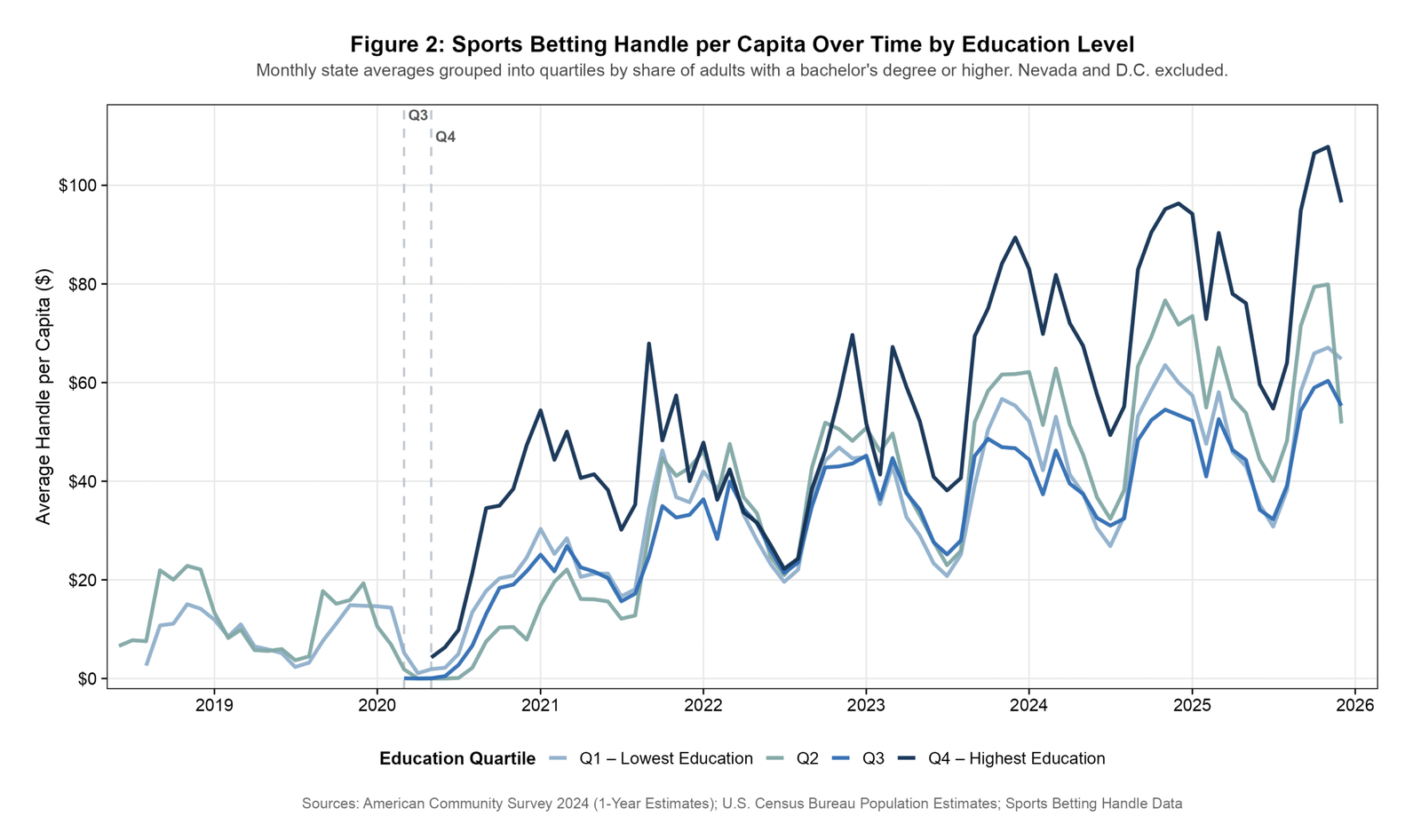
The most educated states have consistently wagered more per person, and this gap has persisted as the legal betting market has matured. In the chart, education quartiles are based on states’ current bachelor’s-degree attainment, while mon-thly averages reflect only those states with legal betting markets active at each point in time. Q3 and Q4 become more visible in 2020, when highly educated states first legalized and launched online betting. Since then, the most educated states have consistently held a higher betting rate. Again, this may be more related to wealth and differences in gambling rules between states rather than any particular appetite for gambling among the college-educated.
For states outside of the top quartile, the story is less clear. Q2 tends to trend higher than Q3 and Q1, and Q1 passed Q2 in the most recent data. The chart also reveals the seasonality of sports betting; activity tends to peak in the fall and early winter during the height of the college football and NFL seasons.
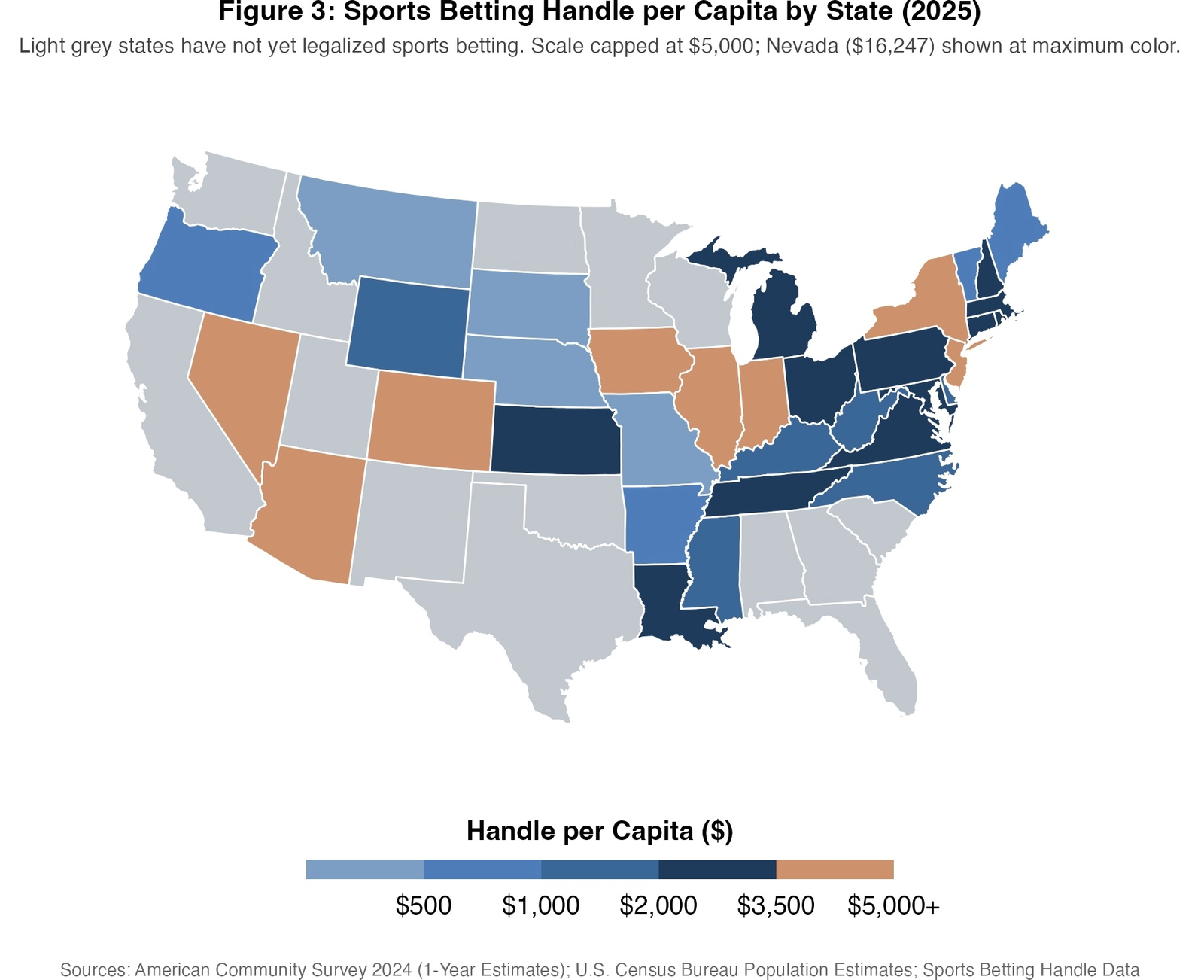
The geographic picture reinforces the conclusion that education is only weakly related to sports betting. Rather than clustering along predictable demographic lines, the highest handle per capita states are spread from coast to coast and include more-educated states like New York, New Jersey, and Illinois as well as less-educated states like Iowa, Indiana, and Arizona. This suggests that other factors, like early legalization and permitted online betting, play a larger role than education in driving betting activity.
The findings carry an important implication. It would be reasonable to assume that higher levels of education would make populations more resistant to the expansion of sports betting, whether through greater financial literacy, stronger awareness of gambling’s risks, or simply different leisure preferences. The data suggests otherwise. Sports betting appears to be a consumer market in which higher educational attainment offers little evidence of restraint.
-
Nevada and Washington, D.C., are excluded as structural outliers. Nevada’s betting market is unusually shaped by tourism and the central role of gambling in the state economy, while Washington D.C. was excluded as a structural outlier because its small, highly urbanized population make it less comparable to state-level markets.↩︎