Current political movements in West Africa have been underpinned by the Western media’s obsequious analysis of emerging leaders to a caricatural extent. Images of Ibrahim Traoré in a persistent red beret, marked by singular out-of-context quotations, mask a larger movement within the region. In the past five years, military takeovers have occurred in a domino effect, with similar motivations, goals, and adversaries.
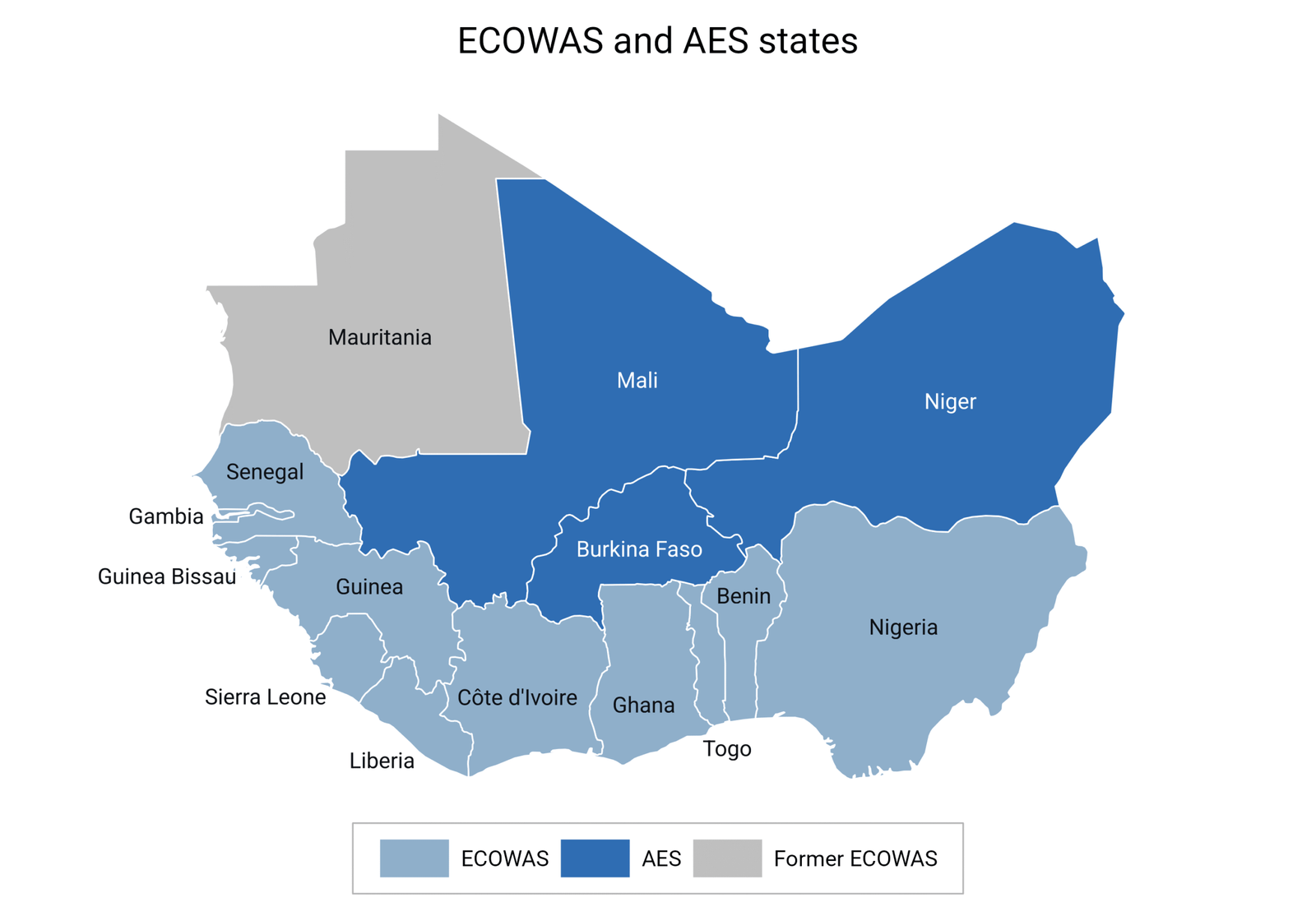
Leaders in Mali, Niger, and Burkina Faso have laid the foundation for emancipating their local economies from Western support. This marks a pivotal turning point in post-colonial trade dynamics. The states are landlocked countries in West Africa, located in the Sahel region. This zone transitions from the Sahara Desert in the north to the tropical savanna in the south. Mali relies on gold mining as its economic driver, with significant deposits of lithium, uranium, iron ore, and phosphates. Niger’s economy is primarily driven by its large uranium deposits. It is ranked among the world’s top producers. Alongside their uranium reserves are significant oil, coal, gold, and various mineral deposits. Burkina Faso is one of Africa’s top gold producers, with mining driving the local economy. The country also holds substantial deposits of zinc, manganese, phosphate, limestone, nickel, lithium, and copper. All three states are resource-rich and strategically advantageous in the global race to enhance local mass production in Western states. The presence of these resources, combined with the unmatched potential of local manufacturing and supply chain processes within the West African states, is a testament to the parasitic stifling inflicted by their relations with Western entities. For Malians, Nigeriens and Burkinabes, a coup d’état is a remedy for an infection spread through infrastructure, trade, and geopolitical alignment.
In the second-largest West African country, primarily characterized by its harsh desert or semi-desert terrain, Mali has become accustomed to the coerced exchange of power. Dating back to the country’s infancy in 1968, the state has witnessed a tumultuous political history, including five major military coups. However, the “coup within a coup” led by Vice President Assimi Goïta is of particular significance not only within the state but in its echoed resonance in the region. The Coup d’état in Mali was not the result of a sudden inflammation of anti-government sentiment. Rather, it was the result of long-term over-exhaustion of the population. Rising insecurity, alleged corruption, and a failing economy left the average patriot with no choice but to protest. Decisions made by the government at this point left a minority of the population and external entities as true beneficiaries of state resources. The anti-government sentiment seeped into the crevices of the nation over time and left only room for the celebration of the ousting of the prominent leaders after a government reshuffle. Mali’s then-President, Bah Ndaw, and Prime Minister (PM) Moctar Ouane were detained by mutinous soldiers loyal to Goïta and driven to a military camp near the capital following their announcement of the reshuffle. Their detention was met with reprimands from the African Union, the Economic Community of West African States (ECOWAS), the European Union (EU), and the United States. External bodies called for the release of Mali’s top politicians without preconditions. At this point, it is important to reiterate that President Ndaw and PM Ouane came to power following a coup d’état in early September 2020. Their ousting occurred the following year in May 2021—the “coup within the coup.”
Amid strenuous political instability, the region faces a security risk that calls for its dependence on external military units. A common adversary of the three nations in question is the uprising and spread of jihadist groups across their shared borders. Even though Mali was forcibly exchanged through multiple hands, all agreed that the presence of the French military was necessary to keep the spread of these groups at bay. Only recently have leaders and opposition started to explicitly speak out against the French presence in the nation, going so far as to admonish their continuing interference in the state. Paul Melly, BBC’s West Africa Analyst, noted Imam Dicko (a highly recognized opposition figure to previous Malian governments) accusation of France’s shift to recolonize Mali, a move that went beyond its stated intentions of military intervention in January 2013. Here, in the accusation, lies the backbone of the anti-government and subsequent resistance to existing regional economic common groups, which persisted not only among the self-appointed leaders but also among the citizens of the nations they claim to be emancipating.
Directly to the East of Mali sits Niger. The country is characterized by its primarily rocky desert, the Ténéré desert, and the Aïr Mountains, in the north, and arid plains in the South. Like Mali, the first coup occurred in the newly independent country’s infancy in 1974. In July 2023, General Abdourahmane Tchiani ousted President Mohamed Bazoum and formed the Conseil National pour la Sauvegarde de la Patrie (CNSP). He then promptly suspended the constitution and dissolved state institutions. Following the recent seizure of power, notes of sombreness were enveloped with jubilations as the locals rode around and chanted, “Down with Macron!” “Down with France!” The same themes of exploitation ring amongst the ousted government officials as new self-appointed leaders symbolize emancipation from Western influence and colonial entity interference. Acts of salvation and timely interventions are the choice descriptors General Abdou Assoumane Harona, Governor of Niamey, used when he sat down with Channel 4 News following the insertion of the new government. “There were no elections, but it was legitimate because it is what the people want,” he affirms.
What drove military officials like General Harona to absolute definitions of legitimacy? Previous leaders exploited the population for the benefit of elites and Western interests. Poor living conditions and corruption from self-interested governance fueled resentment against France, the former colonial ruler, and its influence over elites. This discontent shapes the people’s vision of legitimacy. At the same time, Jihadist groups expanded their foothold in the region, and security deteriorated. Security, meant to be preserved, justified the previous presence of French military units. Thus, French actors raise the question, “if not us then who?” Who will intervene as Jihadist groups gain strength in the Sahelian region? Pan-African Activist Kemi-Seba, addressing the coups on Channel 4 News, said: “Russia can help us, Iran can help us, Cuba can help us, Turkey can help us,’ as long as ‘military cooperation does not equate to colonization.’ Kemi-Seba reflects a shared sentiment during the government’s transition. There is an understanding that these states cannot stand alone without risking failure. Outside actors are vital, but only on the terms of preserved autonomy. French and local entities acting in their name are no longer welcome in the Sahelian states.
All in all, Burkina Faso’s takeover was not unique. The government’s upheaval echoed a regional movement. This overview follows the context of neighboring states. Burkina Faso lies to the southeast of Mali and to the southwest of Niger, and is dominated by a gently undulating savanna plateau. The terrain is marked by sparse and dry landscapes in the north, which transition to more forested savannas in the south, and rugged sandstone cliffs in the southwest. In 2022, the country saw two coups, the first, in January, brought Lt. Col. Paul-Henri Sandaogo Damiba to power. The second, in September, saw Captain Ibrahim Traoré overthrow Damiba. Since Traoré has thwarted multiple assassination and coup attempts. Despite promises of security, Islamist groups continue to worsen conditions as they cross borders. Reports of massacres, civilian targeting, and violence against Fulani persist. At the same time, Traoré’s junta cut security ties with France and moved toward Russia, joining anti-French sentiment unifying the narrative of the region.
The anti-French sentiment can be decomposed into a negative disposition towards French influence. Influence, a umbrella term for the intangible hold on large demographics, is the name of the game. In Niger, Mali, and Burkina Faso, influence is tangible, manifesting not only in military aid, but also in corporate presence and trade relations. The adjacency of a nation to the West has seemingly been taken as an indicator of success, yet it has continued to stifle growth. One cannot help but question and attempt to predict the efficacy of the military governments in the region as they isolate themselves from the AU, ECOWAS, and Western influence to form their own alliance, the Alliance of the Sahel States.
Quantifying influence is an arduous task; quantifying power and control first is, arguably, simpler. The starting point is the historical framework of “Françafrique,” which is the system through which France maintained economic and political leverage over its former colonies’ independence. Versions of this control exist across the continent, reflecting the varying colonial entities that once existed. Central to this system is the CFA Franc currency zone, used by 14 African countries and pegged to the Euro, which requires member states to deposit a significant portion of their foreign reserves with the French Treasury. In blunt terms, it is a siphoning system designed to maintain France’s economic power while stifling growth and preserving dependence. Ondriaš et al. argue that this arrangement constrains monetary sovereignty and limits domestic investment capacity, reinforcing structural dependence (Ondriaš et al. 2024). Empirical evidence developed the argument further. (Keho 2021) highlights that trade balances in West African Economic and Monetary Union (WAEMU) countries are persistently negative and improve primarily through exchange rate adjustments, a mechanism largely unavailable under the fixed CFA system.
As previously alluded to, French economic domination has been sustained through corporate control in key sectors. Major firms such as TotalEnergies, Orano, and the Bolloré Group have historically controlled significant portions of the region’s extractive industries and logistics infrastructure (Ondriaš et al. 2024). Regarding Niger’s uranium deposits, mining accounts for roughly 70% of exports while contributing only a small share of GDP. This disproportionate distribution illustrates the limited domestic benefits of resource extraction under this system–a common occurrence within the immediate region. Exploitation has become one and the same with each state’s daily agenda and inevitably contributed to growing political and economic discontent. If the person in charge is not looking out for the best interest of their fellow countrymen and rather entities with a history of oppression and suppression within, to whom do you turn? If the foundations of your country have exploitation deeply embedded, what do you do?
Start anew–at least some version of it. The AES is Mali, Niger, and Burkina Faso’s attempt at this version. Their regional realignment and decoupling from France align with broader theoretical insights into post-colonial trade dynamics. (Head et al. 2010) demonstrate that while independence often has limited immediate effects, trade between former colonies and their colonizers declines significantly over time, with reductions of up to 65% after several decades. Importantly, they find that “hostile separations” produce more rapid and pronounced declines than gradual or negotiated transitions. The AES case closely fits this pattern: military coups have been accompanied by the expulsion of French forces, the cancellation of long-standing corporate concessions, and the introduction of new trade barriers. These actions accelerate the erosion of what Head et al. describe as “trading capital”—the networks, institutions, and relationships that sustain elevated levels of bilateral trade—leading to a faster realignment of trade flows.
France’s economic control in the region had been slowly but steadily declining prior to the coups, as evidenced by empirical data. However, the decline has accelerated significantly in their aftermath. (Ondriaš et al. 2024) document a steady reduction in France’s share of both imports and exports across former colonies between 1995 and 2022. In Mali, France’s share of imports fell from over a quarter to just over 6%, while its role as an export destination diminished to near insignificance. Similar trends are observed in Burkina Faso and Togo, a former coastal French colony in West Africa south of Burkina Faso, indicating a broader regional pattern of disengagement. Post-coup developments have intensified this trajectory. In Niger, the revocation of Orano’s uranium concession—covering one of the world’s largest uranium reserves—represents a major assertion of economic sovereignty with significant implications for both Niger and France, given the latter’s reliance on imported uranium. At the same time, the introduction of an AES import levy on goods from ECOWAS states and the divestment of French-controlled logistics assets signal a deliberate dismantling of the institutional and infrastructural foundations of French economic influence.
Rather than creating a vacuum, this disengagement has been accompanied by a reorientation toward alternative partners. Russia has expanded its presence in the region primarily through security cooperation, while China has deepened its role through infrastructure investment and trade relationships that emphasize non-interference (Jau and Silva 2025). These shifts reflect a broader strategic recalibration by AES states, aimed at diversifying their economic relationships and reducing dependence on Western actors. At the same time, discussions around exiting the CFA Franc system and establishing a new regional currency highlight a growing emphasis on monetary sovereignty. However, historical precedents suggest that such transitions carry significant risks, and the success of any new currency regime will depend on careful macroeconomic management, particularly given the sensitivity of trade balances to exchange rate dynamics (Keho 2021).
Despite the growing body of literature on Françafrique and the recent geopolitical shifts in the Sahel, important gaps remain. Much of existing research relies on data that predate the most recent coups and lack a detailed analysis of trade flows at the commodity level. Additionally, while theoretical frameworks such as those developed by (Head et al. 2010) provide valuable insights into long-term patterns of trade erosion, they do not fully capture the dynamics of rapid, coup-driven separations. It is vital to address these gaps by examining bilateral trade flows between France and the AES states during the 2020–2025 period, with a particular focus on the mechanisms driving economic realignment. By integrating quantitative trade data with analysis of institutional changes—including currency arrangements, contract revocations, and regional realignments—the exploration and assessment aim to provide a more precise account of both the pace and processes underlying the decline of French economic influence in the Sahel.