

In Dobbs v. Jackson Women’s Health Organization (2022), the Supreme Court ruled that the US does not guarantee a right to abortion, handing power back to the states. Their decision overturned the 49 year precedent established in Roe v. Wade. As of 2026, 21 states have enacted abortion bans or significant restrictions relative to the Roe v. Wade baseline (McCann and Schoenfeld Walker 2024).
The level of abortion care now varies significantly depending on what state a person resides in, which means future medical professionals may decide where to practice based on whether they will be able to perform an abortion. Under Roe v. Wade, abortions were protected until the fetus reached the point of viability, around 22-23 weeks of pregnancy. The Dobbs decision has allowed states to pass stronger abortion laws, which has reduced access to reproductive care, decreased abortion training, and increased the risk of pregnancy complications. Considering these drastic changes in health-related outcomes, it is natural to ask how this might affect the labor market for medical professionals across the US. Experienced and established medical professionals are likely to be relatively inelastic to changes in abortion care, so investigating this effect through medical students’ choices for residency positions may provide insight into how abortion policy affects medical training decisions and the future availability of reproductive healthcare providers.
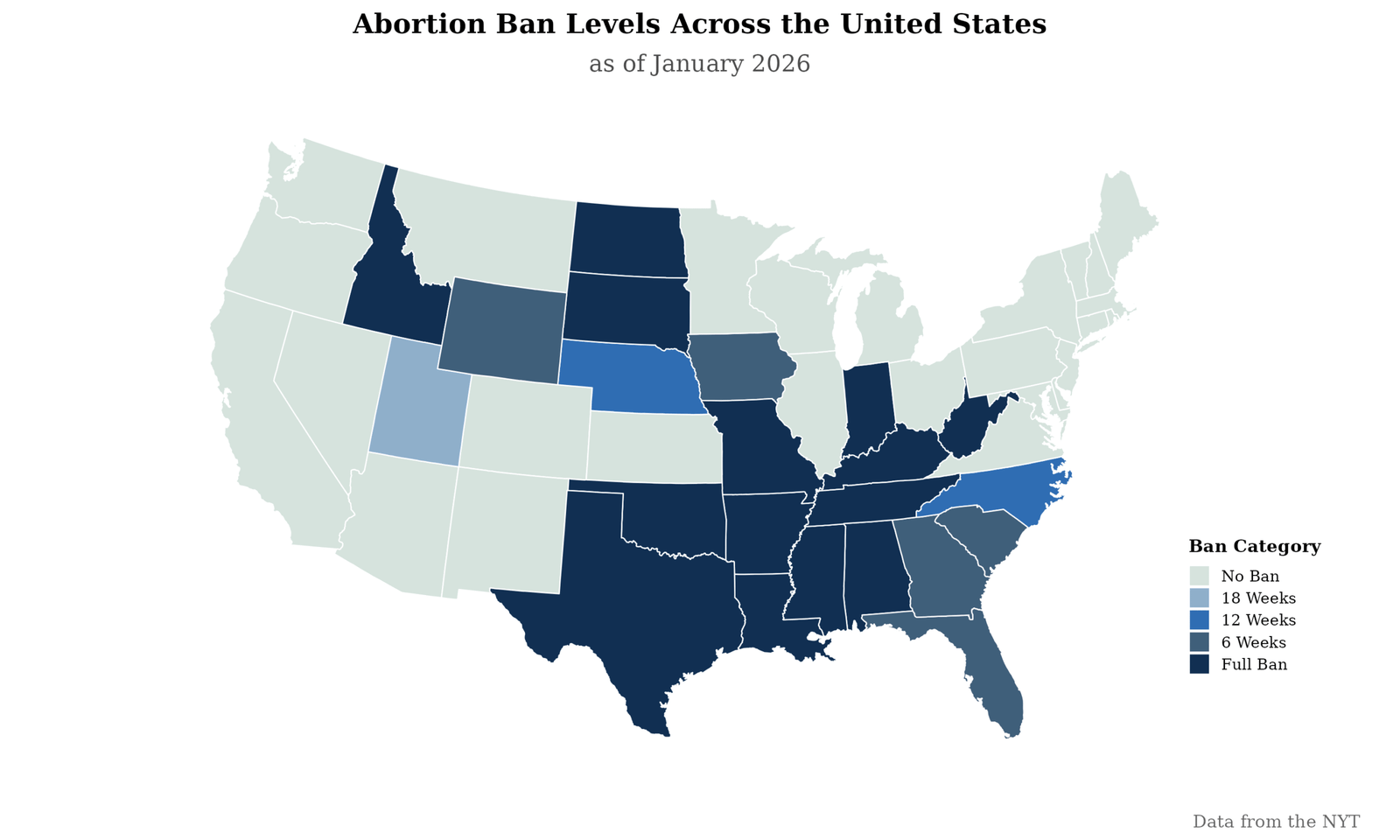
Residents’ choices to practice in certain states due to abortion access may cause a lack of highly skilled medical professionals in these areas. For OBGYN practitioners, these are called maternity care deserts: areas with no specialized doctors or medical centers providing maternity care (Kolb 2024). Before the abortion rights were handed to the states, these deserts existed in 35 percent of U.S. counties (Kolb 2024). Resident’s decisions may have lasting effects on access to reproductive healthcare. Driving doctors away now because of abortion access may lead to medical deserts where people may not be able to get the expert care they need.
Literature Review
Recent studies have begun assessing impacts of state abortion laws post-Dobbs. Orgera and Grover (2024) perform an exploratory data analysis on the effects of the Dobbs decision on the U.S. MD seniors and their application to medical residencies. The authors found a small increase in OBGYN applicants and overall, a possible reduction in residency applicants in states with abortion bans as relative to states with lesser bans or no bans at all. Similarly, Hammoud et al. (2024) assessed the changes in where OBGYN residents applied based on abortion restrictions in states after the Dobbs decision. Their study found that applicants in the 2023 match cycle remained stable overall, but there was a possible decrease in the number of applicants in states with abortion bans.
There has been empirical work done on this topic. Woodcock et al. (2023) use a mixed-methods survey to analyze if graduating OBGYN residents are sensitive to state abortion restrictions after the Dobbs ruling. The authors estimated the likelihood of changing future practice plans against various relevant explanatory variables. They found that OBGYN residents who intended to practice in abortion-restrictive states before the Dobbs decisions, were 8.52 times more likely to change their state of practice. Ganguly et al. (2026) investigates if the Dobbs decision caused a decline in residency applications to abortion-restricted states, and if this varied by applicant gender and specialty. Through their analysis, they found that there was a difference in applications from both genders in states with abortion restrictions compared to those with no restrictions.
| Weeks into Pregnancy | Category | Level of Treatment |
|---|---|---|
| 24 | No Bans | 0 |
| 18 | 18 Weeks | 0.25 |
| 12 | 12 Weeks | 0.5 |
| 6 | 6 Weeks | 0.75 |
| 0 | Full Ban | 1 |
Conclusion
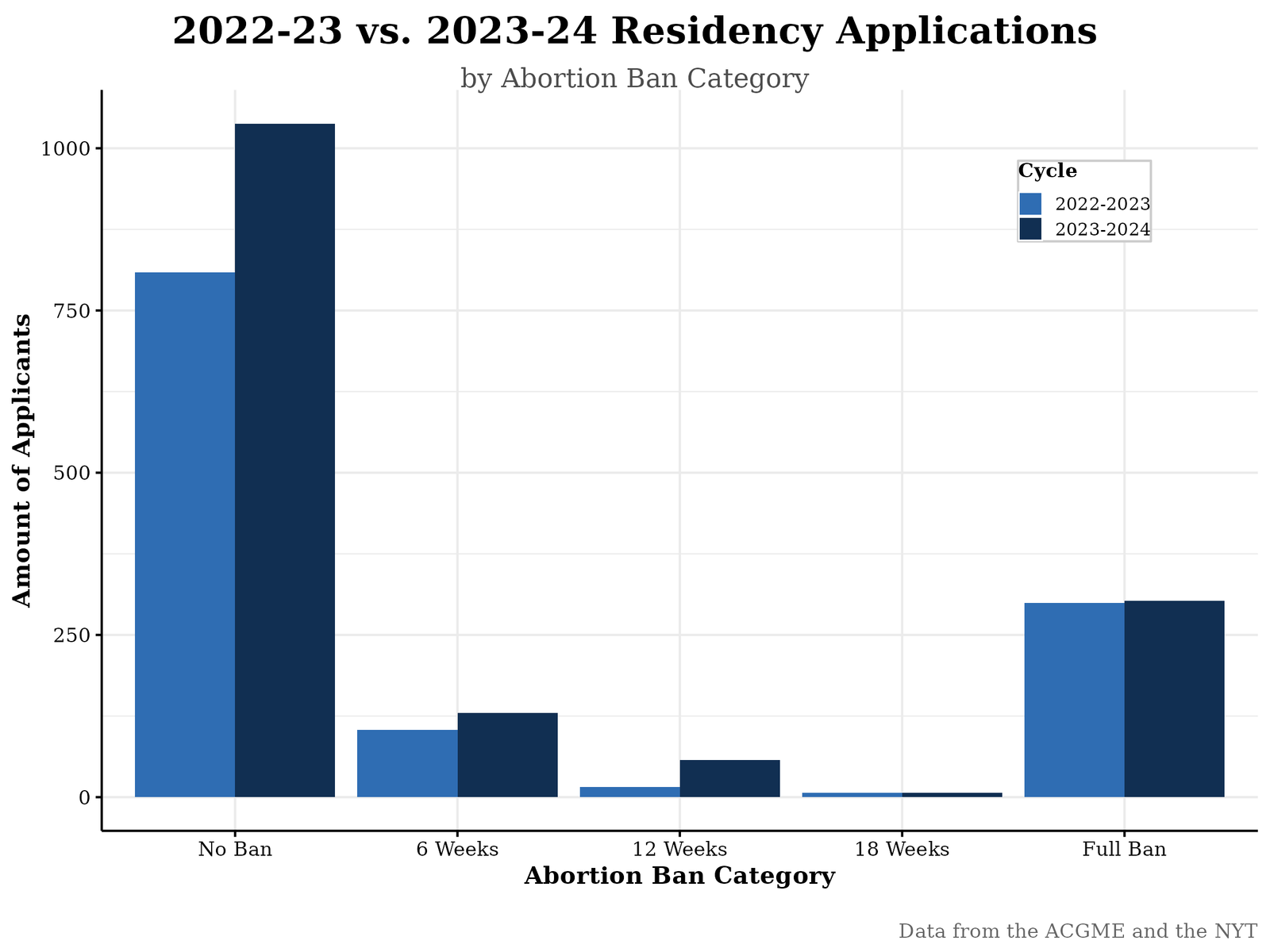
Ultimately, there is no definite answer on if graduating medical students–specifically OBGYN students–going into residency are changing where they apply based on abortion laws across states. In Figure 2, we do see an increase in application amounts for no ban states; however, there are little differences in the amounts of applications for other restriction levels.
The choices of our future medical professionals are integral to a community’s health now and in the long term. This change in residency applications is worth exploring in order to ensure adequate medical care in all areas of the United States.