
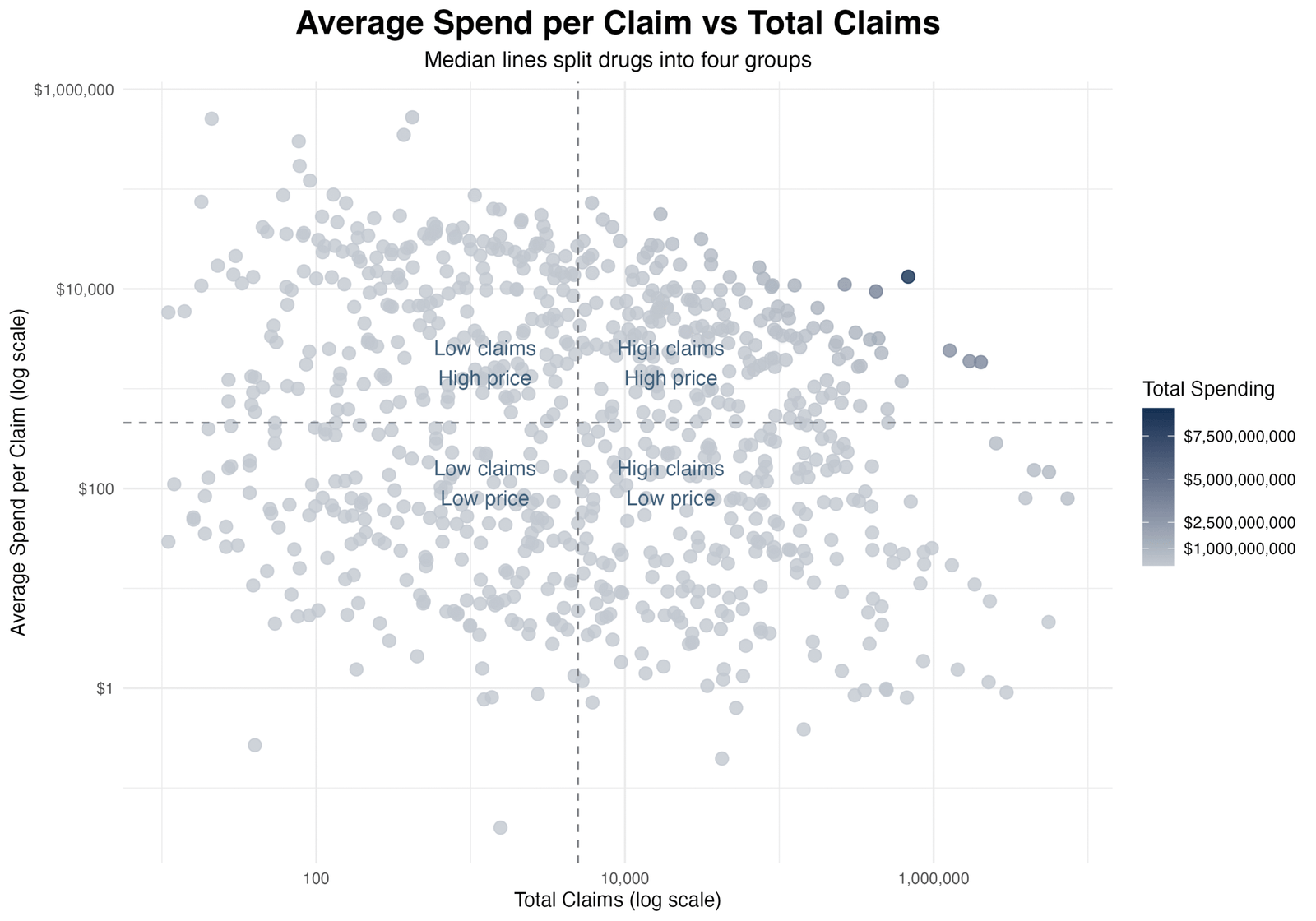
Medicare is a federally run health insurance program that serves Americans 65 years and older, as well as people with certain qualifying disabilities, such as kidney failure or ALS.7 Medicare Part B, in particular, covers drugs administered in outpatient settings, including injections, infusions, and physician-delivered treatments, making it the primary vehicle through which some of the most expensive therapies in modern medicine reach the elderly population. Using data from the Centers for Medicare & Medicaid Services (CMS), two figures lay bare a striking and consequential pattern: the programme’s greatest financial burden is not borne by the drugs used most frequently, but by a small cluster of high-cost treatments for long-term, chronic conditions that remain, as yet, without a cure.
A simple comparison makes the point clear. The ten costliest drugs account for roughly as much spending as the other 778 treatments combined, the bottom 95% of the Medicare Part B market. Most drugs, then, are not where the money goes. Spending is instead concentrated in a small set of treatments that are both expensive and widely used. These drugs dominate the totals not because there are many of them, but because each commands a high price and is prescribed at scale. They place the greatest strain on Medicare’s budget, and, in doing so, indicate where the financial pressures in American healthcare are most acute1.
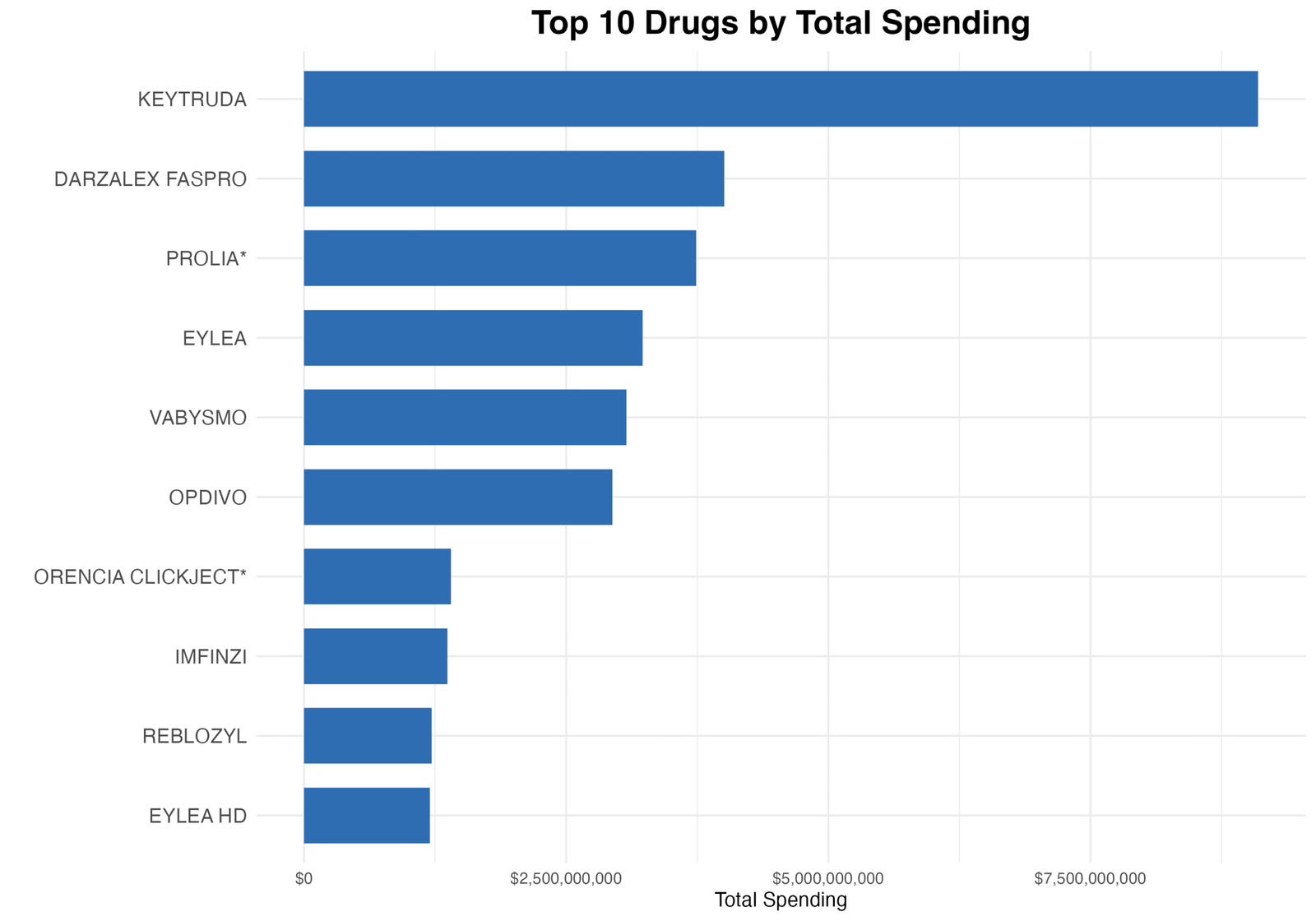
No drug illustrates this more starkly than KEYTRUDA (pembrolizumab), Merck’s blockbuster cancer immunotherapy, which stands alone atop the top-ten spending chart, approaching nearly $9 billion in total Medicare Part B expenditure, roughly double the next closest drug1. At a list price of more than $11,337 per 200 mg infusion2,3, administered every three to six weeks for extended treatment courses, costs accumulate rapidly. KEYTRUDA has also amassed one of the broadest oncology approval profiles of any drug in history, covering more than a dozen cancer types, from lung and melanoma to bladder, cervical, and endometrial cancers3, meaning more eligible patients, more claims, and more spending. Crucially, the 2025 reconciliation law’s expansion of the orphan drug exclusion has delayed KEYTRUDA’s selection for Medicare price negotiation beyond 2026, shielding it from the cost controls that have already generated billions in savings for other drugs4. In 2023 alone, Medicare and beneficiaries spent $5.6 billion on KEYTRUDA4, and that figure has only grown since.
The broader pattern is unmistakable: the top-spending drugs — KEYTRUDA, DARZALEX FASPRO, OPDIVO, EYLEA, VABYSMO — are all treatments for chronic, life-altering conditions that medicine can manage, but has not yet cured. What makes these therapies so valuable clinically also gives manufacturers considerable pricing power, pushing costs to levels that often seem extraordinary. Therein lies the tension. The National Cancer Institute directed $7.2 billion toward cancer research in fiscal year 20245,6, and that investment produced breakthroughs like KEYTRUDA itself, yet effective treatments and affordable treatments are not the same thing. As long as the pipeline continues to produce therapies that are clinically powerful but financially prohibitive, Medicare’s spending concentration will simply shift from one blockbuster drug to the next. Data already exist to show where the pressure points are. The most compelling grant application in American medicine may not be written in a laboratory; it may already be written in Medicare’s own spending data.
References
-
Centers for Medicare & Medicaid Services. “Medicare Part B Spending by Drug.” Data.gov, 2025. https://data.cms.gov/summary-statistics-on-use-and-payments/medicare-medicaid-spending-by-drug/medicare-part-b-spending-by-drug
-
Medicare.org. “Does Medicare Cover Keytruda?” 2025. https://www.medicare.org/articles/does-medicare-cover-keytruda/
-
Healthline. “Does Medicare Cover Keytruda?” 2025. https://www.healthline.com/health/medicare/does-medicare-cover-keytruda
-
Cubanski, Juliette, and Tricia Neuman. “Key Facts About Medicare Drug Price Negotiation.” KFF, March 11, 2026. https://www.kff.org/medicare/key-facts-about-medicare-drug-price-negotiation/
-
National Cancer Institute. “NCI Budget Fact Book: Fiscal Year 2024.” 2024. https://www.cancer.gov/about-nci/budget/fact-book
-
National Cancer Institute. “Fiscal Year 2024 Appropriation Brings Clarity and Difficult Choices.” April 4, 2024. https://www.cancer.gov/grants-training/nci-bottom-line-blog/2024/nci-fy-2024-appropriation-brings-clarity-and-difficult-choices
-
Social Security Administration. “Medicare.” SSA.gov, 2026.