
In most of the world, professional soccer operates under a system where success and failure carry immediate consequences. Teams that perform well are promoted to higher divisions, while those that struggle are relegated. Unlike American sports leagues, where franchises remain fixed, this structure creates constant movement and sharp changes in visibility, revenue, and opportunity.
At first glance, the impact of promotion appears to be limited to the clubs themselves. Moving into a top league such as the English Premier League brings a significant increase in broadcasting income, sponsorship exposure, and global attention. However, in many places, especially smaller cities, a soccer club represents more than just a team. It is closely tied to local identity and economic activity.
This raises a broader question. When a club is promoted, does the impact extend beyond the organization itself? More specifically, can promotion act as a localized economic shock that influences the surrounding city or region?
What the Literature Says About Clubs
Most existing research focuses on the financial consequences of promotion at the club level. Across leagues and time periods, the findings are consistent. Promotion leads to large and persistent increases in revenue, while failing to achieve promotion or being relegated results in substantial losses.
A central approach in this literature is to compare teams that are very close in performance but experience different outcomes. Studies often examine clubs that just earned promotion and those that narrowly missed it. Because these teams are nearly identical, differences in their future outcomes can be attributed to promotion itself. These studies find that promotion can generate hundreds of millions of dollars in additional value over time.
These results make clear that promotion is not simply a reward for success. It fundamentally alters a club’s financial path and creates a sharp break between otherwise similar teams.
Why Promotion May Affect More Than Clubs
Although the financial effects on clubs are well documented, the mechanisms behind these gains suggest broader implications. Promotion increases television exposure, expands audience reach, and raises the overall visibility of both the club and its location.
These changes are not confined to the team. Greater exposure can attract visitors, increase matchday spending, and create additional commercial activity in surrounding areas. For cities with strong ties to their clubs, promotion may increase demand for hotels, restaurants, and local services, particularly during the season.
From an economic perspective, this resembles a visibility-driven shock. When a location receives more attention, it can experience increased economic activity through tourism, consumption, and business engagement. Despite this intuitive connection, most research does not directly measure these local effects and instead remains focused on club finances.
Evidence from European Leagues
Industry evidence supports the idea that promotion brings broader changes. In European leagues, the financial gap between divisions is driven largely by broadcasting revenue and exposure.
Promotion into a top division allows clubs to participate in a much larger media and commercial environment. Matches are broadcast to wider audiences, sponsorship opportunities expand, and overall attention increases. Playoff matches that determine promotion are often described as being worth millions because of the revenue and visibility associated with moving up.
These developments also influence the local environment. Larger crowds, increased media coverage, and greater fan engagement contribute to higher levels of economic activity around the club. While these effects are frequently discussed in practice, they are rarely quantified in a systematic way.
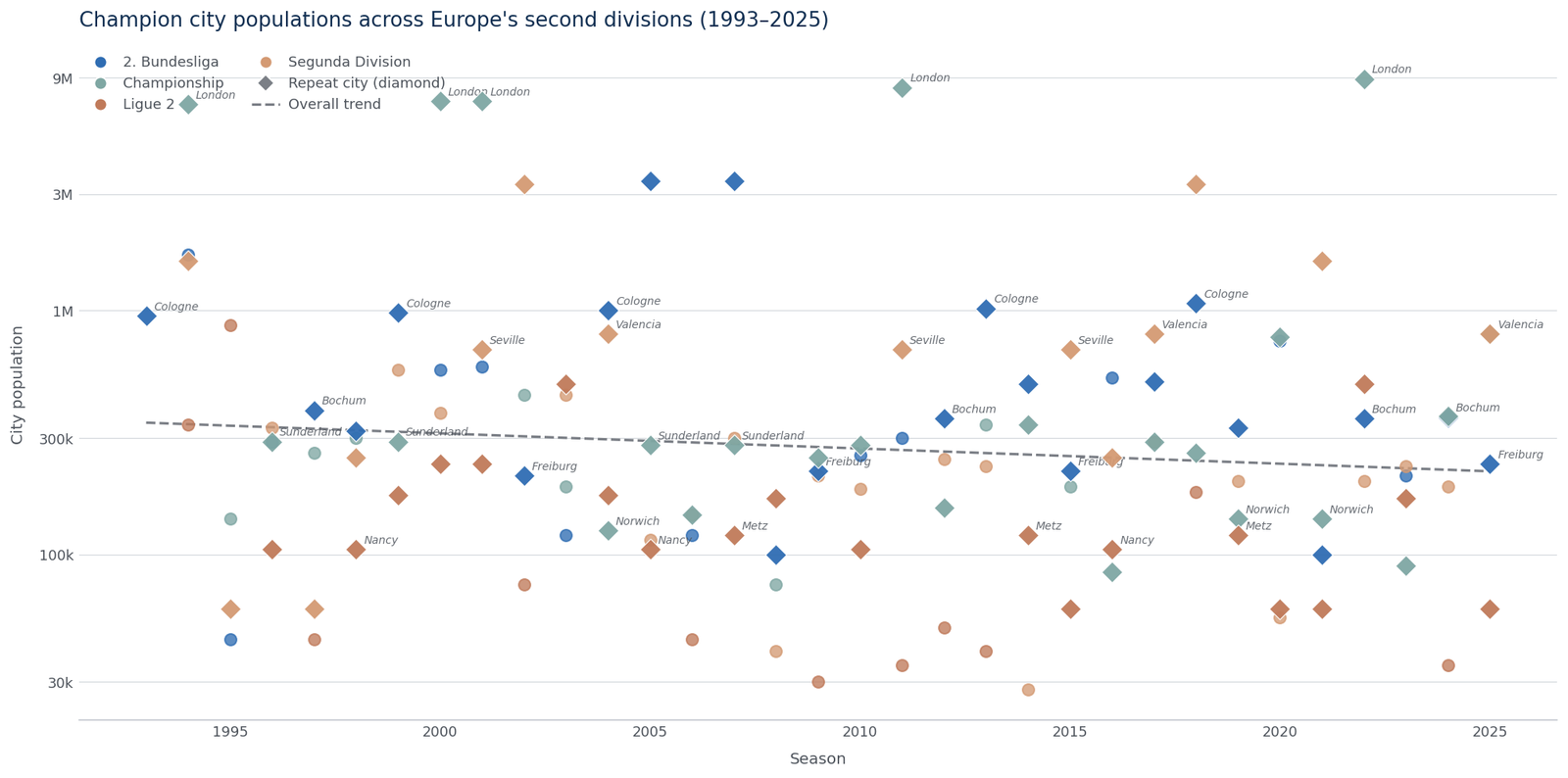
Across Europe’s four major second-division leagues, Germany’s 2. Bundesliga, England’s Championship, France’s Ligue 2, and Spain’s Segunda División, the cities producing promoted champions span a striking range of sizes, from tiny Spiesen-Elversberg (population ~12,000) to metropolitan London (~9 million). Plotted on a logarithmic scale to accommodate this spread, the data from 1993 to 2025 reveals no strong trend in champion city size over time, suggesting promotion has stayed relatively democratically distributed across small and large markets.
England’s Championship is the clear outlier: London clubs appear repeatedly as diamond markers, reflecting how often a single enormous metro area dominates the top of the table, a pattern far less visible in the German, French, and Spanish equivalents, where mid-sized cities like Cologne, Toulouse, and Valencia recur instead.
What stands out most, though, is just how cyclical second-division football is across all four countries. Cities like Bochum, Freiburg, Sunderland, and Metz keep bouncing in and out of the top flight year after year, pointing to a structural ceiling that traps smaller-market clubs between divisions rather than letting them consolidate in the top tier for good.
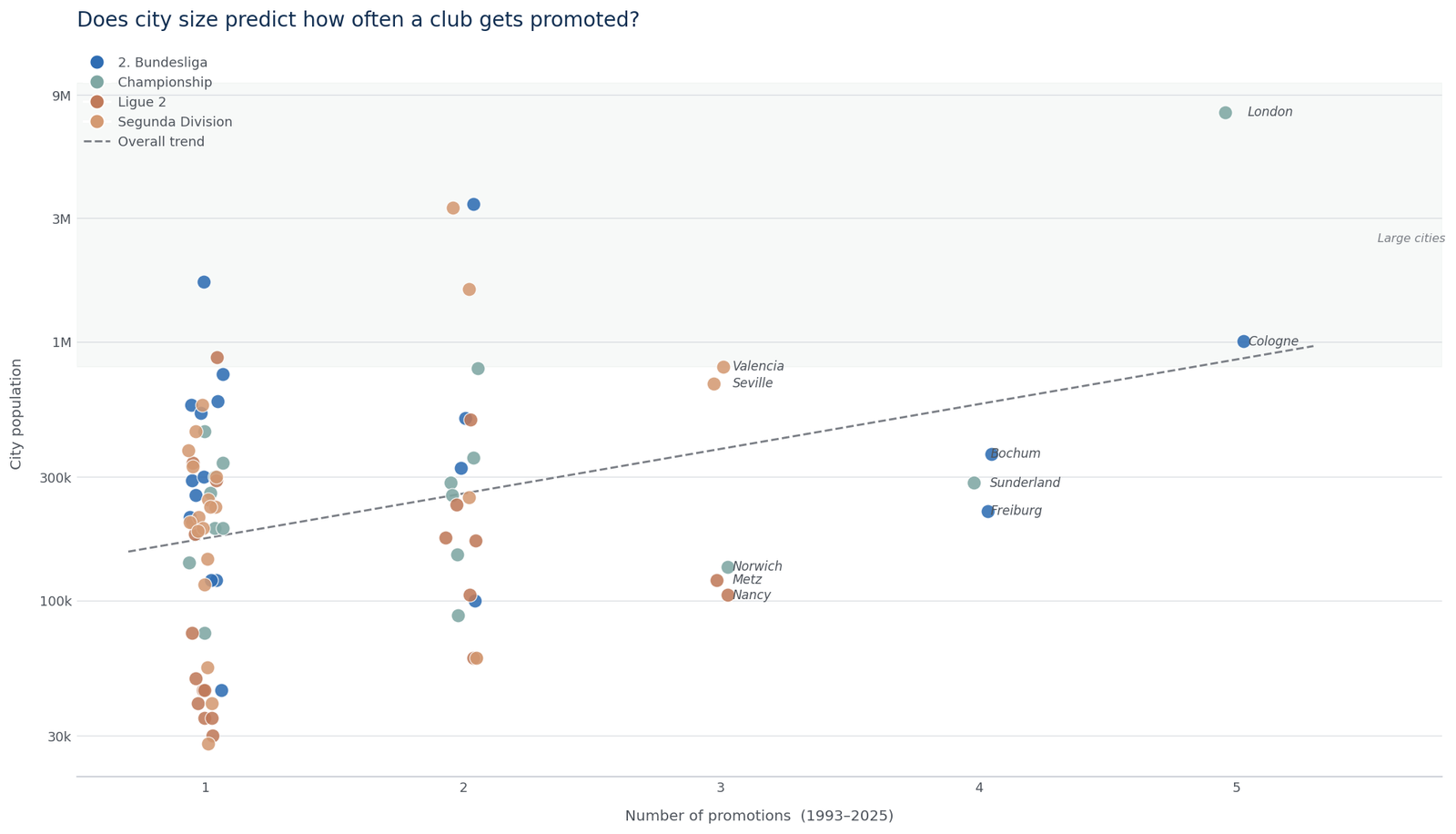
The scatter plot cuts against the intuitive assumption that bigger cities simply produce more promoted clubs. Across all four leagues, the relationship between city size and promotion frequency is surprisingly weak. Mid-size cities like Cologne, Bochum, Freiburg, Sunderland, and Metz cluster at the high end of the promotion count axis despite populations well under a million, while genuinely large cities like Madrid and Barcelona appear no more frequently than much smaller ones. London is the only clear exception, driven almost entirely by the sheer number of clubs the city fields rather than any single dominant team.
Current Literature
The economic consequences of promotion and relegation have been studied most rigorously at the club level. Jamin Speer’s regression discontinuity study is the benchmark here, comparing clubs that just earned promotion against those that narrowly missed it to isolate the causal effect. He finds that promotion is worth roughly $238 to $280 million over the following seven years, while relegation costs clubs a similar amount.
Roger Noll takes a broader view, arguing that promotion and relegation changes how clubs behave strategically, not just what they earn. Teams facing the possibility of promotion or relegation invest more aggressively in players, push wages upward, and compete harder at the margins. Noll finds this has a measurable effect on attendance and club spending, though its impact on overall competitive balance across a league is less clear.
Applied evidence from specific leagues shows these dynamics in practice. Coverage of Serie B playoff finals regularly frames the final promotion spot as being worth tens of millions, driven almost entirely by the jump in broadcasting revenue that comes with top-flight status.
Conclusion
The literature clearly shows that promotion in European soccer has large financial consequences for clubs. It increases revenue, changes incentives, and shapes long-term performance.
At the same time, promotion likely has broader implications that extend beyond the club itself. By increasing visibility and attracting attention, it may influence economic activity in the surrounding area.
Understanding these local effects is important. If promotion acts as a localized economic shock, then its significance goes beyond sports and provides insight into how exposure and investment can affect entire communities. This remains an open and important area for further research.