Introduction
“Today we’re making one of the hardest decisions in the history of our company,” Block CEO Jack Dorsey wrote, as he announced that the company would cut its workforce from more than 10,000 employees to about 6,000.
Normally, companies cutting jobs would worry investors, not excite them. But Block’s announcement, and other recent workforce reductions tied to AI, have been received differently. In a sample of 27 layoff announcements from early 2026, firms that tied their cuts to AI saw their share prices rise by an average of 1.9% on the announcement day, while those who didn’t saw an average decline of 0.1%.
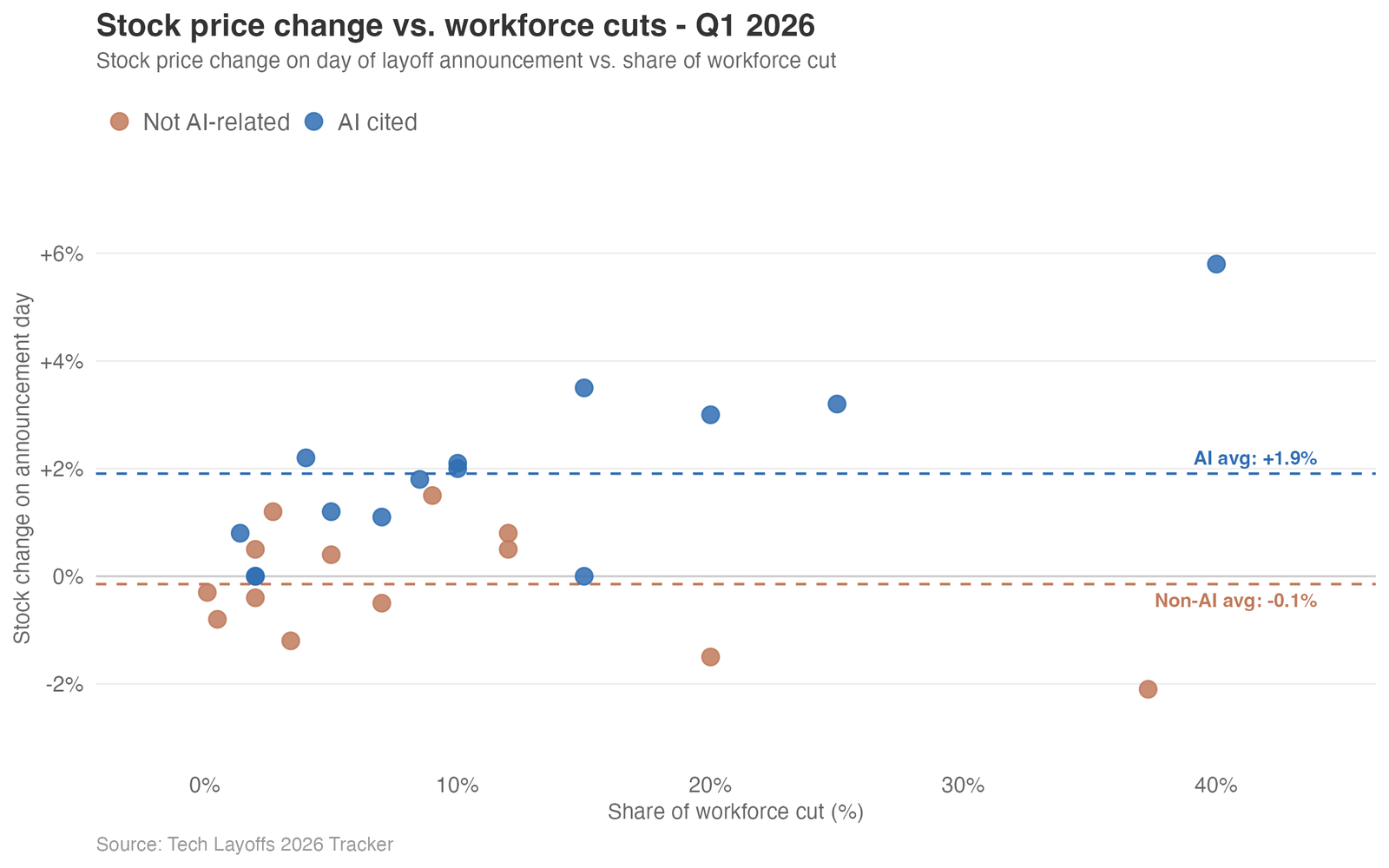
The difference is not a coincidence — a statistical test across the 27 companies in this dataset returns a p-value of 0.0007, meaning there is less than a 0.1% chance the gap between the two groups is due to chance alone.
When companies link layoffs to AI, investors usually see it as a good sign. The idea is simple: the company is cutting costs now and expects technology to keep output steady or even increase it. That suggests higher profits in the future, which pushes the stock up. Layoffs on their own, however, don’t get the same reaction. When they are tied to weak demand, failed deals, or business problems, investors see them as a warning sign. In those cases, cutting costs points to decline, not improvement. What investors really care about isn’t the layoffs themselves, but what they mean for the company’s future. Right now, mentioning AI is one of the strongest ways a company can signal that it expects to grow.
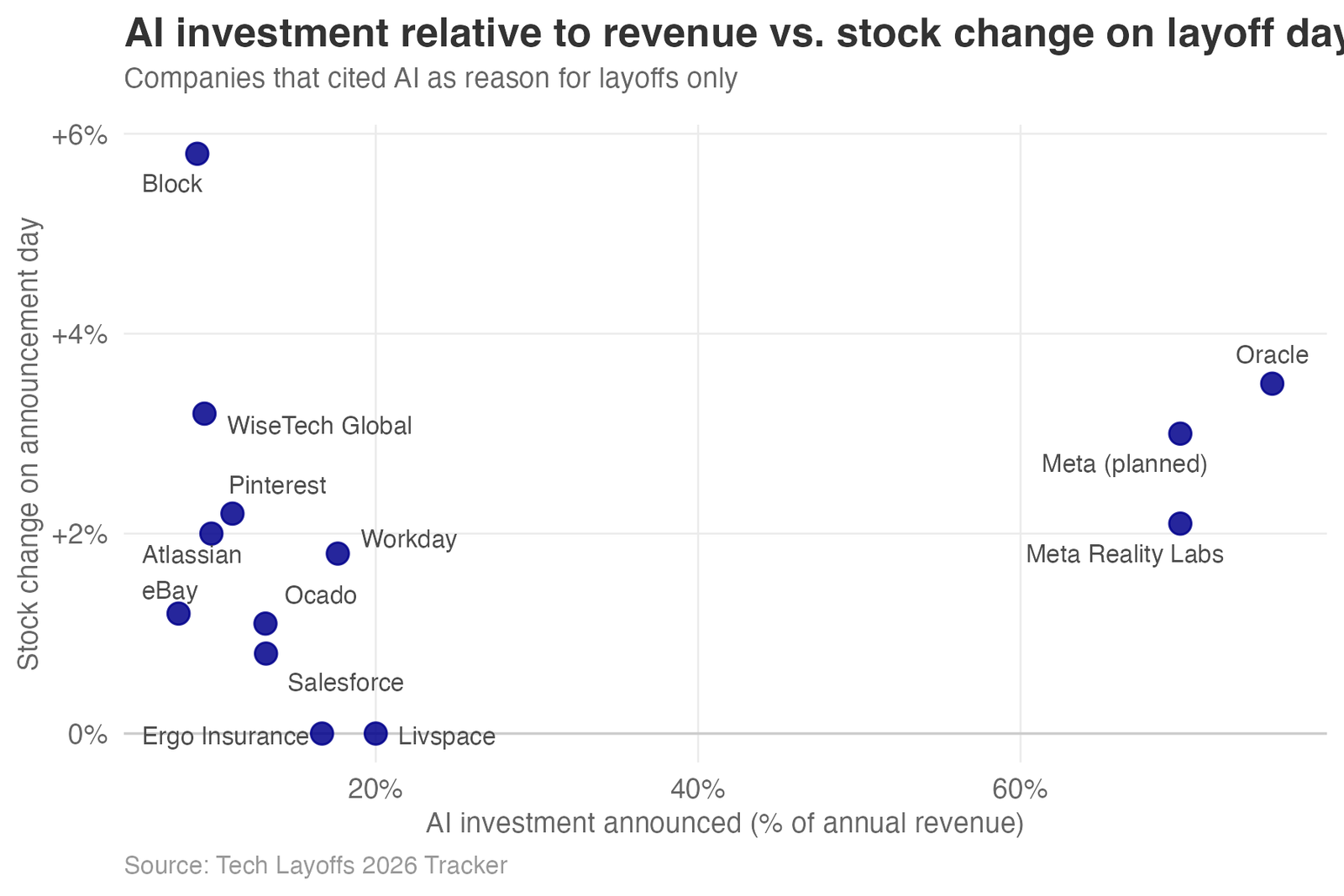
Among companies that announced AI-related layoffs, investors seem to be indifferent to the magnitude of announced AI investment. Block, for example, put about 9% of its annual revenue toward AI and saw the biggest stock jump in the group, up 5.8%. Meanwhile, Oracle and Meta committed much larger shares, closer to 70% of their revenue, and saw more modest gains. This suggests investors are not just reacting to how much is being spent. Instead, they are judging the story behind it. What matters to investors is whether or not the AI strategy feels clear and believable, and whether the layoffs match that shift. For instance, smaller, more focused moves can come across as decisive, while larger investments can seem uncertain or overly ambitious. In the end, markets reward not the scale of spending, but how convincing the plan appears.